Category Archives: Optimising Democracy

Every country on earth now needs a Peace Minister

You personally must engage in demanding it.

In our increasingly tense world, why should  all our governments have “Ministers for Defence”, perhaps even for “War”, but not for “Peace”? It does not make sense, does it? Peace is the matter of prime importance for the well-being of people everywhere in the world. The horrible pictures of homes destroyed by bombs and drones tell us that without peace everything suddenly falls apart. As the global news tell us, it can happen to all of us, from one day to the next.

So, can you imagine 193 global “Peace Ministers” from each nation – 193 is the current number of member states in the United Nations – to proactively work together to create and maintain peace in the world?  They would be wisest people picked from each nation. They would check what the ultimate interests of people and nations are and how these interests can be balanced, so that instead of war, destruction, and suffering, peace and cooperation are created.

Presently much of the world talks about considerably upgrading their military investments. But, given the predominant importance of peace for our well-being, why not also double our efforts to create and maintain peace? Having 193 wise people in the world working for peace would costs us only very little money in comparison to all the billions of expenditures for military equipment, but it would be of extreme value for humanity, for everyone on earth. Presently the world is becoming increasingly tense. Having “Peace Ministers” from all over the world working for global peace will change our focus, it is likely to make this world a far better place.

The key issue is: Without you, without all of us engaging and jointly putting this demand forward, it will not happen.

So, if you want peace in the world, you must now take action. You must join forces with all people devastated about the tension, the wars, and conflicts in the world. Why not talk to your friends and colleagues, why not demand and, if necessary, protest for the creation of the position of a “Peace Minister”, or more precisely perhaps, a “Minister for Peace and Cooperation”, in your nation? Peace in the world depends on you, on all of us taking joint action.

The world clearly should have 193 Peace Ministers, shouldn’t it?

_____________________________________________________________

According to the great American president Abraham Lincoln democracy is  “government of, by, and for the people”. (He exhorted us not to let democracy die to honour the many fallen for democracy and for our own sake.)

If we start from this fundamental definition, then the question posing itself and which we must answer is, what the exact purpose of this system of “government by the people” should or must be?

If we assume (we need to discuss and agree on this) that the prime purpose of the democratic political system is to support the well-being of the people, next to the second goal of maintaining our societies and our world in a sound state for future generations, then a systematic analysis of the factors affecting our wellbeing makes clear that not only the ability to defend ourselves is important for our well-being. “Creating and preserving peace” rather is a far more crucial, a central precondition for the well-being of everyone on earth. There can be no well-being at all without peace.

But amazingly, despite this crucial role of peace for the world and for the well-being of people, so far most governments on earth have a “Defence Minister”. But that does not help us much.  As we now see, when those drones start flying above our homes at night and bombing our homes, then it is too late, our well-being is finished. To preserve our well-being, our efforts must start far earlier. It is far more useful and sensible to proactively engage in creating and maintaining peace than simply spending (or wasting) 5% of all our public income on weapons. After all, our resources are already scarce, the money we are spending on military equipment around the world is so desperately needed for other purposes, such as social support or for maintaining our planet. Ultimately, the Bible has a reason, when it calls for “beating swords into plowshares”. This is plainly far more sensible for ensuring human well-being then to pour scarce resources into weapons. Certainly, we may have to be able to defend ourselves, but our prime focus must clearly be on creating and maintaining peace.

So, on the situation in Palestine: Let us assume we have Peace Ministers from all nations jointly investigating together with the Peace Ministers of Israel, of Palestine, Iran, and neighbouring Arab nations, how to create peace in Israel and the Palestinian people. Basically, the Ministers could start their endeavours within four weeks’ time.  (It does not take longer to find the wisest people in our societies and to appoint them for the task, does it? It is a matter of the highest degree of urgency.)

What could those Peace Ministers achieve?

The crucial thing they would realise is that it really does not make sense at all for two nations and other nations involved, to be at war for seven decades, to keep killing each other, to keep destroying resources, homes and towns, and to spend billions if not a trillion on weapons. Had these funds been spent over the decades on building two co-operative and friendly nations, then life for the people both in Israel and Palestine would be utterly better. The Peace Ministers would also make it clear that humanity cannot afford such conflicts at all in our world when we are apparently in the process of destroying the earth as we know it. For humanity to lead wars in this critical situation is utter madness.

The Peace Ministers would, therefore, now help to finally create peace in Palestine and initiate what should have started seventy or so years ago, the building of two neighbourly and cooperative nations. They would convince the Arab nations that the Jewish people needed a refuge after six million were killed during WWII, that, as we all know, the Jewish people have a historical connection to the area, and that there is enough space to build two neighbouring nations. They would finally point out that making space for others, when it is available, is a matter of good will and that Islam, like other religions as well calls the believers to help their “neighbours”. For the sake of the people in Palestine and for the sake of humanity, it is now high time to finally create a peaceful and co-operative situation in Palestine.

What could the Peace Ministers do for creating peace in Ukraine?

First, if all nations supporting Ukraine would appoint Peace Ministers offering to investigate and to negotiate options for creating peace in Ukraine that would make a significant public statement about the constructive intentions of the West.

The measure would set Russia under pressure to follow suit and to appoint a Peace Minister too. So far, the motivation of president Putin to lead war in Ukraine appears largely incomprehensible. What really are the interests of Russia and its people? And how can we do them justice? The Peace Minister would make the goals of all parties and the options for arriving at a peaceful cooperative arrangement publicly visible and engage the people in the process of creating peace and cooperation.

As it appears, also in Ukraine, leading war does not make sense at all, it kills people and destroys resources, it substantially compromises the well-being of people not only in Ukraine but also in Russia. Ultimately leading a war in Ukraine is a crime against humanity in a time when humanity needs to use all resources it has only available for stopping Climate Change and the destruction of the planet as we know it. Instead of leading wars, we humanity must work together with the highest degree of urgency and use all resources available on earth with the greatest degree of effectiveness and efficiency to protect the planet.

All over the world, the Peace Ministers the Peace Ministers would analyse the factors driving conflicts and, together with the people, search for solutions. For all people in the world, the Peace Ministers would create a different focus in the world, away from all the bad news about conflicts and wars, to something positive, to humanity thinking about how we can live together in peace and taking the required steps. 

Yes, ultimately, we and our nations may have to be ready to defend ourselves. But the more we  focus on creating and maintaining peace, the better for us. The less need will there be for wasting global resources on military equipment. This shift in priority must be reflected in the fact that all governments in our nations make both, “creating and maintaining peace” the prime concern of their foreign policy, and that each government now appoints a highly respectable personality ideally from outside of established politics as their “Peace Minister”.

Ultimately, as Lincoln declares,  democracy is government by us, the people. This means that every citizen, we all jointly, you personally, must now ensure our governments now appoint a, in the official title, peace and cooperation are tightly connected, “Minister for Peace and Cooperation”.

So, if you want to preserve, or to create and maintain, a peaceful and cooperative world, send letters to your government. Join in peace protests demanding that your government makes a wise person of proven integrity and standing a “Minister for Peace and Cooperation”.

Not only peace in the world, but its entire existence depends on you taking the necessary action for your government to appoint a Minister for Peace and Cooperation.

Unhinged: A situation of chaos in the world

What our governments and we ourselves must now do to have a chance to cope effectively with the situation.

Presently there seems to be great chaos in the world. People everywhere are depressed about what is going on. Everything is enormously complex. It is difficult for us to identify and agree on the necessary steps forward. Also our governments seem overburdened.

How do we get out of the chaos?

It appears that the guiding principle must be to look for the key parameters driving the solution.

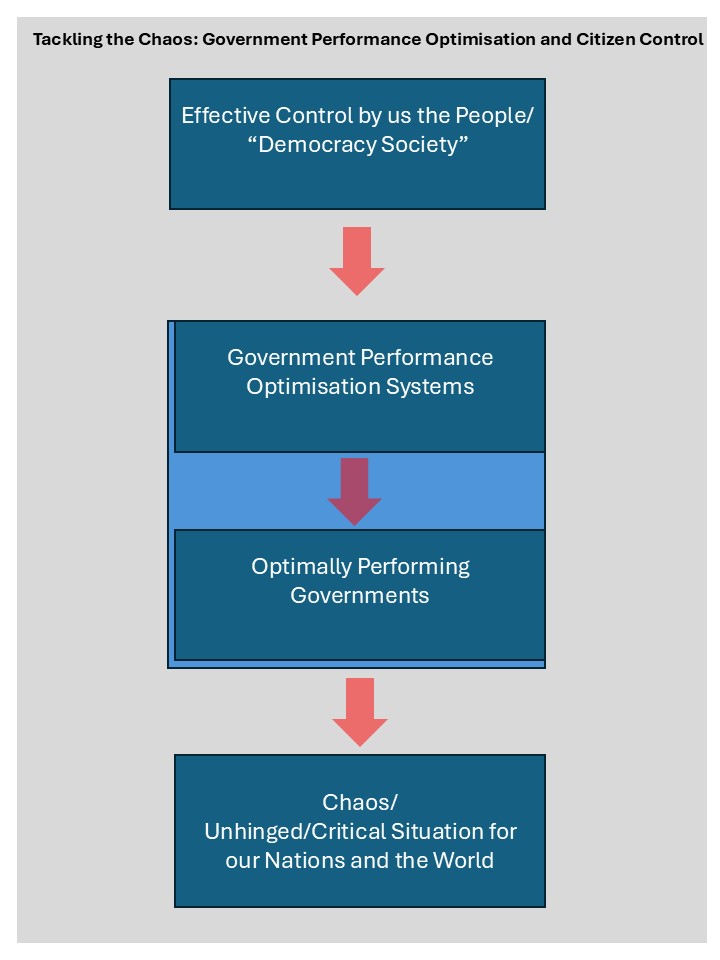
I suggest there are two such parameters: First, the optimal performance of our governments, and second, more decisively even, our effective control as citizens over our governments.

I. Our governments must optimise their performance.

Our governments are the systems, the tools, and the institutions, with which we as societies, national or even as global society, develop, and implement the solutions for our political problems.

A key step for us is to recognise that we only then stand a chance to solve the extremely complex problems which our societies and the world are facing, if our problem-solving systems, our governments, are working optimally.

This means that our heads-of-government, must now optimise the performance of the governments, which they lead for us, they must as soon as possible introduce a “Government Performance Optimisation System”.

Answering the question, how to govern optimally, cannot depend, however, on the personal whims and convictions of a single person or a limited group of persons. The optimisation of government performance rather necessitates taking recourse to all know-how distributed in the nation and the world. To ensure the optimisation of government performance heads-of-government must arrange for an open and comprehensive consultation with society on the issue and implement its conclusions.

II. We, the citizens, must exert effective control over government.

Since governments will either not be aware about such fundamental suggestions on their performance – there is  a huge amount of information out there for them to digest – , or they will simply ignore them, perhaps because they are overwhelmed by the day-to-day necessities of governing, it is indispensable that we as the citizens realise that democracy is “government by us, the people”.

This is a privilege and a responsibility. “Government by the people” means that we, as the people, must exert effective “control” over the systems with which we govern, it means that we need to ensure that our governments operate as effectively and efficiently as only possible. Concretely, we must ensure that our governments establish the required “Government Performance Optimisation System”.

Of course, we as individuals largely have no say in the work of governments. For us to exert effective control over our government and to ensure that government operates optimally requires joining forces and resources. Concretely this means we must create and join a “Democracy Society” in our nations.

Participating in elections every four years or so or even not-participating in them at all does not suffice or measure up. Maintaining a functioning society and a functioning democracy rather requires active citizenship. We need to get together once a week, perhaps a Friday afternoon, and consult about how to build and maintain functioning societies and democracies. Together we need to assemble the optimal know-how on how to ensure the optimal functioning of our democratic governments. Since government is “all about systems”, systemic problem structuring methodologies appear to be a precondition for getting to sound results.

Conclusion

Of course there are many more detailed issues to tackle on how to ensure the optimal performance of our government systems. Clearly, to achieve this goal, our politicians must be qualified “optimally” (we need to define what this means and create suitable systems to ensure they have the require qualifications). Moreover, all systems and processes in the government must function optimally as well, such as strategy and decision making, implementation, communication with the citizens, and many others.

Concretely we desperately also need effective Citizenship Education Systems, one issue our governments fail in addressing in perhaps all democracies, a failure which seems to be responsible to a large degree for the problems of our democracies.   

At the same time there is no use in submitting proposals in the public debate when we do not have effective systems in place for the assessment of such proposals and for making sure they are implemented if deemed beneficial.  For this we clearly need the proposed “Democracy Societies” in our nations.

Certainly, depending on their state, in some nations it will be more difficult than in others to implement the proposals made here. If society is suppressed by the rulers it might be impossible, at least for now.

In any case, for us to deal effectively with the huge challenges our world is facing, we need optimally functioning governments.

It seems that our governments would be obliged to install effective Government Performance Optimisation Systems now, without delay, if they do not want to be responsible for the collapse of our democracies and the world.

In our critical situation it appears necessary that we rethink our role as citizens in our society. It appears to be our responsibility as citizens to make sure that our governments perform optimally. The indispensable starting point appears to be to get together on a regular basis to discuss and clarify how to move forward to an effective solution for the chaos in our world.

Mr. Merz, what does “to govern” mean at all? …

The “million-euro Gretchen-question” to the new chancellor-elect of Germany

Does the new chancellor-elect in Germany know at all what the term “to govern” means exactly and which exact actions the term necessitates and comprises? What exactly is the correct definition and understanding of “to govern”?

As the victory of his party became apparent on election day, Sunday, February 23rd,  Mr. Merz, the new chancellor-elect of Germany fended off pushy journalists declaring : “Today is a day of rambazamba, of (wild) celebration. We will start working tomorrow, Monday.”

People have anxiously been awaiting the outcome of the elections in Germany. They fear the rising right-wing populism and the potential collapse of German democracy, they wonder whether the politicians are capable at all to handle the huge challenges which the nation and the world are facing. After the failure of the last coalition government, Mr. Merz will now have to work hard to assemble another probably three-partite coalition as soon as possible and to make it “govern effectively”. Also for Europe it is of fundamental importance that Germany now gets a high performing and stable government.

But for the government of Mr. Merz to now govern effectively and to save German democracy from a potential collapse in the next election he and his government needs to know what “to govern” means exactly, and which activities the act of “governing” comprises precisely.

Without having  a joint clear definition and understanding of governing, Mr. Merz will not be able to form a new coalition government and it will not be able to govern effectively and efficiently. The new coalition government must fail again and will endanger German democracy.

So, Mr. Merz, what is “governing” exactly? And how can you find the best answer to the question?

Is the German public going to challenge Mr. Merz to answer these questions as he engages in forming a new government?

Democracy is government by the people. The public have a right to know and need to clarify with the government what “governing properly” entails at all. Ultimately, getting the foundations of government right and communicating effectively with the public on the work of government is the first requirement in establishing trust in a democratic government.

P.S.: One should of course put the question, what does the term “to govern” mean and comprise exactly, also to Mr. Starmer, M. Macron, and any other head of a democratic nation. It would be very interesting to hear what they have to say.

……………………………………

Here the text for our German readers:

Herr Merz, was ist eigentlich „regieren“? …

Die “Millionen-Euro-Gretchen-Frage” an den voraussichtlich neuen Bundeskanzler Deutschlands

Weiß der neu gewählte Bundeskanzler in Deutschland überhaupt, was der Begriff “regieren” bedeutet und welche Handlungen er genau erfordert und umfasst? Was genau ist die richtige Definition und das richtige Verständnis von “regieren”?

Als sich am Wahltag, Sonntag, dem 23. Februar, der Sieg seiner Partei abzeichnete, wehrte sich Merz, der neu gewählte Bundeskanzler Deutschlands, gegen zu aufdringliche Journalisten mit der Erklärung: “Heute ist ein Tag des Rambazamba, des (wilden) Feierns. Wir werden morgen, Montag, mit der Arbeit beginnen.”

Mit Spannung haben die Menschen auf den Ausgang der Wahlen in Deutschland gewartet. Sie fürchten den erstarkenden Rechtspopulismus und den möglichen Zusammenbruch der deutschen Demokratie, sie fragen sich ob die Politiker überhaupt in der Lage sind, die riesigen Herausforderungen zu meistern, denen sich die Nation und die Welt gegenüber sehen. Nach dem Scheitern der letzten Koalitionsregierung wird Herr Merz nun hart arbeiten müssen, um so schnell wie möglich eine weitere, wahrscheinlich wiederum Drei-Parteien-Koalition zusammenzustellen und sie “effektiv regieren” zu lassen. Auch für Europa ist es jetzt von grundlegender Bedeutung, dass Deutschland so bald wie möglich eine leistungsfähige und stabile Regierung bekommt.

Aber damit die Regierung von Herrn Merz jetzt effektiv regieren und die Demokratie vor einem möglichen Zusammenbruch bei den nächsten Wahlen bewahren kann, müssen er und seine Regierung sich darauf einigen, was “regieren” genau bedeutet und welche Tätigkeiten die Aufgabe des “Regierens” genau umfasst. Ohne eine klare, gemeinsame Definition und ein klares Verständnis von Regieren kann eine neue deutsche Regierung nicht effektiv und effizient regieren. Sie muss wieder scheitern und wird die deutsche Demokratie gefährden.

Also, Herr Merz, was genau ist “Regieren”? Und wie finden Sie die beste Antwort auf diese Frage?

Wird die deutsche Öffentlichkeit Herrn Merz herausfordern, diese Fragen zu beantworten, wenn er nun mit der Bildung einer neuen Regierung beginnt?

Demokratie ist „Regierung durch das Volk“. Die Öffentlichkeit hat ein Recht darauf zu wissen und muss mit der Regierung klären, was “richtig regieren” überhaupt bedeutet. Letzten Endes ist die Schaffung der Grundlagen der Regierung und die effektive Kommunikation mit der Öffentlichkeit über die Arbeit der Regierung die erste Voraussetzung, um Vertrauen in eine demokratische Regierung aufzubauen.

P.S.: Man sollte natürlich die Frage, was der Begriff “Regieren” bedeutet und welche Aktivitäten er genau umfasst, auch Herrn Starmer, Herrn Macron und jedem anderen Oberhaupt einer demokratischen Nation stellen. Es wäre sehr interessant zu hören, was sie zu sagen haben.

Biden – The Savior of Democracy?

So far, half the job done.

To complete it Biden needs a highly effective Government Performance Management System without delay.

What a world of a difference in the entire conduct of the inauguration ceremony, the decent and measured speech of Biden, the thoughtful and classy poem by Amanda Gorman, and in the deep prayers spoken at the inauguration in comparison to the swampy culture of lies and indecencies of the Trump years which increasingly threatened to devour the US.  What a relief not only in Washington, but around the world. In a time when democracy globally is under extreme strain, the health of the leading democracy in the world is of crucial importance for human freedom and dignity.

Nobody except Biden could have ousted Trump, state many voices in Washington. So, must we consider Biden the savior of US and perhaps of global democracy?

One thing is undeniable: We owe the greatest admiration and respect to Joe Biden who at 78 years takes on the gigantic challenges the US and the world are presently facing.

Yet, by ousting Trump the job of saving US democracy is only half done. Biden and his excellent team face an extremely difficult mix of policy tasks from overcoming the pandemic, getting the economy back on track, creating jobs and an economically more balanced nation with equal chances for everyone and fighting racism. Furthermore, they only have around two to three years – even less, if one takes the mid-term elections in two years into account – to unify the nation and to stabilize democracy to ensure that a populist politician like Trump will not be elected again. How can Biden achieve success in handling this wide array of extremely difficult and urgent policy tasks?

Practically all democratic leaders in the world believe that running a government optimally is a matter of personal judgement, be it their own or the advisers around them. Yet, if Biden wants to succeed, it is crucial that he and his associates do not fall into this trap. Prevailing over all these challenges in the short time available is only possible with a government system of the highest degree of effectiveness and efficiency. To get it Biden needs a government performance management system which itself operates extremely effectively.

This idea is not new. Ten years ago, the Obama administration in fact already recognized the need for government performance management to make government as effective as possible. It appeared to be a frontrunner among global governments on the matter. But a quick look shows that the approach the Obama administration pursued was inadequate. A presentation from the year 2011 by Shelley H. Metzenbaum, from the Obama administration, and A. Alfred Taubman from the Brookings Institution, lists the three “key elements” of its government performance management concept:

 a) Leaders set clear, ambitious, outcome-focused goals for a limited number of priorities,

 b) Agencies measure, analyze, and communicate performance information to drive progress on their priorities,

 c) Leaders frequently review progress on their priority goals.

These key elements appear fuzzy. What is the “limited number of priorities” supposed to be and of which benefit are “frequent” reviews of progress on priority goals? The approach to performance management by the Obama government evidently misses out completely on a systemically indispensable first step for making any system effective, the need to confirm and agree on its exact goals.

As Hélène Landemore from Yale University writes in her book “Democratic Reason”, the fundamental key to optimal policy making is optimal deliberation, the inclusion of all know-how available in society and the world on a policy problem. It is also the indispensable prerequisite for ensuring effective government performance management. The fuzziness of the approach to performance management by the Obama administration shows that the first step required in creating an effective government performance system through such public consultation is the identification of a suitable methodology.

One concrete suggestion at this point will be: For Biden and his team to ensure the success of the government in unifying US society and stabilizing US democracy and in coping with all the other difficult policy issues it is facing, they must base their approach to making government work on sound systemic thinking. The methodology requires the thorough verification of the precise goals and purposes of the democratic policy making system and of each process in the system. It then entails the exact determination of each and every factor affecting the achievement of the goals identified and ensuring that these factors are in place. If the Biden government does not work diligently through these steps in making government effective, it will not operate as effectively as it must.

While the combined experience of the Biden team is a great asset, given that many of its members were in government, when the increasing discontent with the political system allowed Trump to get into office, it also entails the risk for government to continue exactly as before. “How do we do government?” “What must we improve?” In the light of what is at stake for the Biden government and the nation, a structured independent assessment of the overall quality of the policy making process which investigates these questions appears indispensable.

In the current situation it would be a dangerous mistake for the government to believe that it will achieve the critical goal of stabilizing US democracy simply by solid and effective policy making in the wide array of areas which it is facing. Given the complexity of the tasks, chances are that government success over the next two years or so will not be far-reaching enough to convince the great majority of the citizens of the merits of a decent democratic government.

Effective systemic government performance management will highlight that the goal of stabilizing US democracy rather must be treated as a distinct policy area on its own. It will emphasize that, next to aiming to deliver on the expectations of the people in such areas as jobs, healthcare, and equal rights, the Biden government must involve the people in the process of policy making so they see how it works and can trust in it. The aim of making democracy more resilient at the same time calls for the implementation of a high quality citizenship education program which conveys to the people what a functioning democracy needs to look like, what the preconditions for effective democracy are, what the personal and professional requirements concerning its leaders must be, and, finally, how the people themselves can engage with their government in a constructive fashion to ensure that their concerns are being heard and taken into account.

Biden will be able to handle the extremely difficult combination of challenges he is facing in the narrow timeframe available only with a government of the highest degree of effectiveness and efficiency conceivable. To ensure his government operates at such level of quality he must open it for new thinking on how to run government effectively. He and his team must install an effective government performance management system without delay.

What Extinction Rebellion should do next – a proposal

  1. The starting point: We need effective political systems to solve complex tasks.
  2. Climate Change is the largest and most complex challenge humanity has ever faced. Our efforts to stop Climate Change will have to involve all people on earth, all areas of life, and all areas of policy making. To solve the problem of Climate Change we need the most effective national and global policy making systems conceivable.
  3. The UK government system is by no means effective. It does not set its priorities right; it does not create effective strategies. Government fails in many ways (Brexit – over three years not able to present a convincing solution, Climate Change, other areas – many democratic governments suffer from such deficits in policy making which we need to fix.)
  4. Already in 2012 (!) the UK Parliament raised the issue: They said that they had “little confidence” that government policies are informed by a clear, coherent strategic approach”. In other words, they said: Government strategy making was completely faulty and ineffective (or “rubbish”, if you like!).
  5. They starkly concluded: Failing to fix the deficits in strategic thinking in government could have “catastrophic consequences”, also in Climate Change! Parliament itself failed, however, as a control institution to make sure the deficit was fixed. (Here the people/XR needs to come in: The people need to make sure that Government does its job properly and that there is an effective control system over Government.)  
  6. In its reactions to the Climate Protests the Government confirms that its strategy making is completely ineffective:
  7. Rather than engaging with the Climate Protesters the Prime Minster so far has said nothing about the protests. She rather acts as a marshal in a local run! (that appears to be blatantly wrong priority setting – considering that the world is at stake).
  8. The reactions of other high government officials to the climate protests were completely inadequate: They suggested for example that the protesters were “clowns” and protesting “against public transport”. They are protesting against the potentially threatening destruction of the planet “as we know it” (Al Gore) and of human civilisation. The first thing the want us to do is to engage in a constructive discussion on the future of the planet and on the strategy in coping with Climate Change. The protests would stop, if the government would enter into such constructive talks. 
  9. As we said we need a political system of the greatest degree of effectiveness to solve Climate Change.
  10. Extension Rebellion theoretically has two options to make sure we have such a system:

a) to set up such an effective system on its own

b) to demand and ensure that the present political system operates as effectively as it must to handle climate change.

  1. Option one is completely unrealistic and nonsensical. The UK Government System and Civil service currently employ around 450000 persons. If we declare a Climate Emergency, this means that all these 450000 persons (plus the entire population of the UK) must somehow be involved in policy making and implementation against  Climate Change. There is no use in wanting to replicate such a system.
  2. XR can only pursue option 2: It must ensure that the existing Climate Change policy making system with the (any) Prime Minister at the top works as effectively and efficiently as only possible – and is possibly restructured and enhanced to ensure that is the case.  
  3. We have zero time to lose in making sure that the Climate Policy System is effective and capable to design and implement an effective strategy against Climate Change.
  4. XR should therefore as a next step put the Prime Minister on the spot. The Prime Minister as the Head of Government is responsible for ensuring policy effectiveness.
  5. It should demand that the Prime Minister immediately names an able Secretary for Climate Change Policy (as a key contact for XR – with adequate qualifications in the structuring of complex problems).
  6. XR must then clarify together with this new Secretary for Climate Change Policy what the most suitable strategy against Climate Change is.
  7. XR must then make sure that the new Secretary for Climate Change (with  the support of the Prime Minister) implements the required strategy.
  8. There is no effective system without effective control.     
  9. XR actually must function as the control system of the people in making sure that government works effectively regarding Climate Change. XR can only then create an effective UK and global Climate Change policy, if it learns how to act effectively as a “Citizens’ Control System” over Climate Change Policy. (By protesting it takes a first step in exerting such a control function.)
  10. Protesting appears necessary to get the attention of government and of wider society. But it is by no means enough. XR must take constructive action to ensure that there is an effective climate change policy system. 
  11. XR demands a Citizens’ Assembly on Climate Change. Also a Citizens’ Assembly, if it is effective, will have to come to the conclusion that an effective fight against Climate Change demands a highly effective policy making system. 
  12. So why not start now? Why not set up an effective process to ensure the effectiveness of national Climate Change Policy now? 
  1. My concrete proposals:
  2. Put the Prime Minister on the spot. Concentrate the protests around Downing Street.
  3. Demand that the Prime Minister establishes an effective system and process to implement an effective Climate Change Policy
  4. Concretely: Demand that the Prime Minister establishes a separate Department for Climate Change (perhaps together with Environment – if the planet is at stake “as we know it” then we need a specific department to deal with such an issue and emergency.)
  5. Demand that the government names a capable Secretary for Climate Change Policy as a main contact for XR
  6. Demand that this secretary for Climate Change works closely with XR on developing an effective UK and International Strategy to stop Climate Change.
  7. If the Prime Minister does not understand: Solicit also the support from Parliament (Public Administration and Constitutional Affairs Committee, Sir Bernard Jenkin MP, responsible for Report on Government strategy making deficits.
  8. If that does not help: Tell the British public clearly that the Prime Minister needs to act and install an effective system to combat climate Change and restart frequent traffic disruptions in London – until the Prime Minister install a new department and secretary for Climate Change Policy.
  9. One must convey clearly to the British public and the people affected by traffic disruptions that the Prime Minister can stop the disruptions immediately by doing what is required: By installing a new Secretary for Climate Change Policy with whom XR can work together.

Hans Peter Ulrich        www.optimizingdemocracy.org        opt_democracy@btinternet.com             22 April 2019

The Climate Protests: A Constructive Way Forward

The Situation

We do not have any more time to lose.

We urgently need an effective process to get us started.

The Scope of The Task

The situation is more complex than anything the world has ever seen before.

We need something like the war effort in WWII, involving all people in society, only this time on an even far bigger scale: We must join with all other initiatives against global warming in the world.

We can only succeed, if we start now and use all resources available in our societies in the most effective and efficient manner conceivable.

The Demands on The Process for Stopping Global Warming

An effective fight against global warming will have to integrate all aspects of life on earth.

It will require substantial changes in the way we live, what we eat, which products we use, how we generate energy.

Maintaining the planet in such a way will cost each of us money.

It is likely to generate fundamental changes in economic structures. Many people might lose their jobs, other jobs will be necessary and created.

We need to pursue not only one, but two goals:

  1. To stop global warming
  2. To maintain society sound and stable, while it undergoes these changes.

There is no use in creating an effective climate policy, if it destabilises and destroys society.

We need a system capable to implement and co-ordinate all measures across all areas of society and of politics: housing, transport, manufacturing, agriculture, research, education, nutrition, international co-operation, international development, international population control and so on.

The consequence: In each country and for the world as a whole we must create the most effective systems and processes conceivable to handle the problem.

 The Necessary Problem-Solving Steps

Solving a complex problem like global warming requires the following steps:

  1. Creating a joint understanding of the problem situation. So far, too many people do not realise the dangers we are in or even deny them. We have to as soon as possible confirm the data and communicate them effectively to society.
  2. Creating a joint understanding of the goals, so everyone can pitch in.
  3. Identifying all factors which affect the goals.
  4. Designing different strategic options.
  5. Deciding on the most effective ones or on the best combination of measures and strategies.
  6. Implementing the chosen strategies or strategy packages.

We can only then generate an effective UK and global strategy to stop Climate Change, if we create the most effective systems and processes conceivable to handle each and every one of these tasks. 

Methods

All of these steps require the highest capacities in problem solving methodologies and quantitative decision-making processes. They must combine the required expert knowledge into feasible strategies.

We need to identify the very best methodologies.

We need to teach people working on Climate Change Policy Making these methods.

We need to select the most qualified people in all these methods for working on climate change policies.

Involvement of the People

All people in society and in the world need to support and co-operate on these efforts.

All people in society need to be involved and understand what is required.

We need to create a highly effective Communication Hub to ensure that is the case.

Protests generate the required attention. But they do not actually stop global warming.

We must come to the most effective concrete measures conceivable.

Everyone can participate in a practical way in stopping climate change:

  • by planting trees in our cities and all over the world,
  • by educating people about alternative ways of nutrition,
  • by doing research on new ways of generating and conserving energy,
  • by advising people on environmentally friendly living and on how to energy protect their homes,
  • by becoming a builder and helping in replacing energy inefficient windows,
  • by helping communities to build better bicycle tracks,
  • by working for a more effective development policy,
  • by advising people in Africa on birth control,
  • or by becoming an expert in solving complex policy issues through studying systemic problem solving methods.

There is an enormous amount of work which needs to be co-ordinated effectively.

A Citizens’ Assembly?

As we said: We need to create the most effective systems and processes conceivable to handle each and every one of the problem-solving tasks.

And that as soon as possible. We have no time to lose.

The question is: Which function in the problem-solving process is a Citizens’ Assembly supposed to fulfil?

Does it have the necessary capacities?

The drawback appears to be: Randomly selected people will not have the necessary methodological know-how. Citizens’ Assemblies also are usually limited in time. Effective strategy design is an ongoing task. Government still needs a highly effective process to check and implement any proposals made by the Citizens’ Assembly.

It may be a start. But it is also a waste of time. Doubling the policy making processes of government is a waste of scarce resources. We rather need to make government climate policy effective.

Proposals for Solution

  1. We install an effective permanent process for citizen involvement co-ordinating all necessary measures to stop climate change.
  2. We demand that the Prime Minister installs now without delay a new specific Secretary for Climate Change Policy in the UK government with the required know-how in methods for solving complex problems.
  3. This Secretary with our support and under the control of the people must immediately put the sketched problem-solving process into place to get us started.

For us it is important to realise:

Without adequate know-how in problem solving methodologies we cannot establish effective measures against global warming.

Best of luck and success    Hans Peter Ulrich   opt_democracy@btinternet.com         20 April 2019

Democracy is a …religion? No, it is a mechanism which we urgently need to fix.

“Democracy is a religion that has failed the poor” states Giles Fraser in his weekly column “Loose Canon” in the British Guardian.

http://www.theguardian.com/commentisfree/belief/2015/may/08/democracy-a-religion-that-has-failed-the-poor

Now, Giles Fraser is a highly intelligent man, a theologian and doctor of philosophy whose column, even if one may not always fully agree, generally contains some stimulating thought.

But is democracy a “religion”?

Certainly, Fraser’s thoughts contain some truth. He points out how piously we pursue a process – voting – even if we may not have any idea whatsoever who to vote for or may seriously wonder which difference our vote makes at all. Giles suggests (with Banerjee) that voting may simply be an “expression of one’s citizenship”.

But then, this makes a mockery of human beings. If one believes in human beings as conscious architects of their world and lives, for them to pursue a more or less useless process which does not ensure a sound management of our nations and world is by no means adequate.

In a way Fraser’s bias as a theologian is understandable. We all look at the world from our personal angle. Changing vantage points, exchange of views is necessary to arrive at the most suited perspective. To talk about democracy as a religion in fact appears highly disconcerting and even paralysing.

If we want to make this world a better place, then we clearly need to adopt a more constructive stance, one of a kind which might come more naturally to managers or engineers: Rather than looking at democracy as a sombre force over which we have no influence, we  need to consider democracy as what it  ultimately is, as a man-made mechanism, which we need to improve, if it fails us. We, humanity constantly work on all kinds of systems, processes and mechanisms which do not fulfil our needs and expectations. Why not fix or improve the way  we practice democracy?

In which way is democracy actually failing us? Following the UK elections, many observers clearly highlight a deficit in the election process, it does not turn votes into adequate representation in parliament. Then there are the issues of devolution and “English votes for English Issues”: The structure of regional representation in the UK is unclear and needs to be overhauled. All in all, we need to check whether each element of the democratic system optimally fulfils the purpose it is meant to fulfil. Generally and perhaps most importantly, like in many democracies there is increasing disenfranchisement between the people and the political system. Democratic policy making needs to be changed in such a way in that it offer new channels for the public to engage in and to take adequate control of the management of public issues.

True citizenship and stewardship for our world means shaping the processes with which we govern it. Since we as individuals do not have any influence, we must join with other citizens to make democracy work. Forming an association called “Citizens Controlling Democracy” will be crucial to ensure that our democratic policy making processes work effectively and represent the interest of all people in society.

In a way we talk far to much, we publish hundreds of articles every week on what needs to happen in politics. If we do not take joint and constructive action to make democracy work, it never will. A machine which was considered adequate fifty years ago, may well not be adequate anymore for our world of seven billion people. It may have to be overhauled and re-engineered.

Democracy – a “mechanism which needs to be fixed”. It would greatly help, if also theologians could adopt and support this perspective.


How to make democracy work? From ideas to structured action.

Words, thoughts and ideas are valuable, if we want to strengthen our democracies. But they do not suffice.

“What’s gone wrong with democracy – and how to revive it” asks the Economist in an essay in its March 1st – 7th edition.
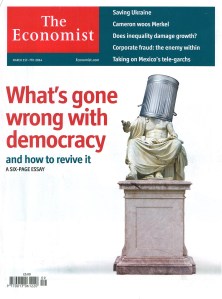
The Economist What is gone wrong with dem Title Picture

http://www.economist.com/news/essays/21596796-democracy-was-most-successful-political-idea-20th-century-why-has-it-run-trouble-and-what-can-be-do

The concern of the article must be appreciated. Functioning democracies are of crucial relevance for the establishment and maintenance of well-being and freedom, for social stability and peace, and in fact for the maintenance of the earth. The Economist article raises many valid issues on the state of our democracies and suggests solutions to a wide variety of deficits.

Unfortunately, the contribution which the article can make to reviving established democracies or to help establish flourishing democracies in crises countries appears very limited due to three deficits: First, the recommendations seem too general in parts, what does “nurturing democracy” the final recommendation in the article, mean precisely for example? What exactly is necessary? Second, the issues the article raises and its proposals are rather randomly selected, they lack a key, a structure. We suggest that in order to strengthen democracy we have to identify the drivers behind the health of democracy and address them systematically.

Third, the essential major deficit, which so many articles on democracy share: The article fails to specify who exactly must take its suggestions on board, who precisely is to examine them and to take concrete action. Words, thoughts, and ideas do not cure our democracies. Making democracy work takes concrete action, by those who are concerned about democracy, by the writers on democracy, and in fact, since democracy is government “by” the people, by all of us. If we are concerned about the state of our democracies, we need to establish an infrastructure responsible to evaluate and implement the required measures to make democracy work. Anybody who has suggestions on how to strengthen democracy must realize that making suggestions does not make much sense without the infrastructure in place to process these proposals.

So maybe we can induce the Economist to perhaps even spearhead concrete action to save and strengthen democracy around the world? If we are serious about making our democracies effective and saving our world, we all must think beyond our traditional frame of mind and activity. We must think and act as constituent and active elements of our democratic societies.

What is democracy?

If we are right with our suggestions on the deficits concerning the article by the Economist on democracy, what then might be a more suitable, concrete approach to making democracy work? The first fundamental, necessary step appears to be the establishment of a clearer joint understanding of what democracy is about.

We suggest that democracy is a form of organizing the peaceful and productive co-existence of people in a society. Concretely it is joint decision and policy making by the people on public issues in such a society in an extremely complex world for the well-being of present and future generations.

(If you suggest a different starting point and a different approach, let us know.)

Fundamental Building Blocks and Action Required

On the basis of this understanding of democracy, we suggest that the following fundamental building blocks and actions are necessary to establish functioning democracies.

1. “Peaceful and productive co-existence “ – Only absolutely necessary rules to be implemented

The foundation for a democracy is the readiness for peaceful and productive co-existence of human beings in a society. In order to ensure that such fruitful co-existence is possible, certain rules are necessary.

According to the psychologist Maslow self-realization, however, is one of the highest aims of all human beings. To minimize the reduction of individual freedom by rules and regulations, only those rules should be put in place in society which are absolutely necessary for the peaceful and productive co-existence of people.

The fundamental rule required for such co-existence is the Categorical Imperative. It means in its basic form that the freedom of people ends where the freedom of other people begins. The Imperative may suffice as a framework for the rules required in a society.

One feature of the world, of Creation, is diversity. People naturally believe in different things. Trying to impose standards and rules derived from a specific conviction or religion on society as a whole limits the freedom of individuals and is counterproductive to peaceful and productive co-existence. (Only if nobody in a society objects to further rules than those necessary for the functioning of a society, can those be adopted. People who join a monastic community for example voluntarily agree to more stringent rules than those necessary for constructive co-existence.)

2. “By the people”

Democracy means that, we, the people govern the affairs of society ourselves. We as citizens in a democratic nation must realize that democracy cannot mean electing governments and letting them make decisions and policies on our behalf, without us as citizens ensuring they perform their tasks effectively and efficiently.

The privilege of freedom, which comes with democracy, demands that we ourselves are constantly involved ourselves in the process of governing the world. If we don’t use our freedom in controlling who governs us and how to govern the world, our freedom will be taken away from us. Uncontrolled power holders might destroy the world. We ourselves govern and are responsible for this world. We must make “our” democratic policy making systems work effectively, so they fulfil this responsibility for us.

3. “Joint” decision and policy making equally by all people

Even if democracy traditionally means that the majority decides, this cannot mean, as the Economist points out, that the majority dominates minorities and compromises their freedom and well-being beyond the limits and regulations which must apply evenly to all members of society. In a democracy everybody needs a fair and equal chance and should be involved in decision and policy making processes. Fairness is the minimum precondition to maintaining a stable society. The more the principle of fairness is superseded, however, by principles of co-operation and mutual support, the more productive will a society be. The better will the society of a nation or, in fact, global society fare.

4. “On public issues”

The Economist article suggests that the “key to a healthier state, in short, is a narrower state”. This appears to be an extreme attitude, as it is often also formulated by the Tea Party Movement in the United States (“starve the beast”).

We suggest that in order to maintain a democracy in a healthy state we rather must identify the “optimal” scope of the tasks of the state. Where a state does not support individual citizens for example who need support, society as a whole might suffer. The “optimal” interplay between joint and individual action will benefit society most.

In order to define such an optimal delineation between the tasks of the state and the obligations and rights of citizens we, the citizens of a democratic society, need an effective system to decide what precisely the tasks of the state and what the rights and obligations of citizens as private individuals should be. In most, if not all, democratic societies such an effective transparent system to delineate the tasks of the state and of private individuals will not yet exist.

5. “For the well-being of present and future generations”

The aim of our joint decision and policy making in a democracy must be the well-being of people, not only of present, but also of future generations. We are obliged to maintain our societies and our world in a good state for future generations as well. Our policy making processes must be geared to take this into account.

6. A complex world: The need to aim for the highest degree of effectiveness

From looking at the state of our world we derive which level of quality our joint policy making processes must have.

Our nations with millions or hundreds of millions of people -in the case of India and China more than a billion – and our world of seven billion people are extremely complex. Defeating poverty and hunger, creating jobs for millions of people, managing national and the global economies, protecting the entire world and human life, stopping the destruction of the world by global warming, creating and maintaining peace and co-operation are highly difficult tasks.

Making democracy work, keeping people satisfied with its performance, and fulfilling our responsibilities to future generations, requires from us to set up the most effective systems conceivable for joint decision and policy making on public matters.

7. Parameters required for setting up effective democratic policy making systems

We suggest that the citizens of a society and a nation require four key parameters to create such joint decision and policy making systems and processes of the highest levels of effectiveness:

7.1. Permanent Citizen Control

No systems works without effective control. Our present control systems, however, do not work. Parliament as the main control system for example, is too much intertwined with government in parliamentary democracies, as one reason.

No democratic policy making system works without the people themselves permanently checking what their elected leaders do. No democratic system will work effectively without a clear identification of faults and deficits and without an effective process to fix them in due time. As we highlighted already: Democracy is government by the people. Democracy will not work if the people themselves do not get engaged in permanently controlling, supervising, and, if necessary, re-shaping their democratic policy making system.

For such effective citizen control over our governments and policy making systems three further parameters are necessary:

7.2. Know-How

In order to correct deficits of the present policy making system and to set-up the best democratic policy making system conceivable, we the people, the citizens of a democratic society, need the very best know-how available in our countries and in the world on these matters. We need to establish a suitable process or institution to assemble this know-how.

The Economist, just like all of us, might have beneficial thoughts and proposals on how to make democracy work better. Whether these ideas are truly the best options, is a different and important question. If we want to optimize our policy making systems, we need effective processes and systems to evaluate these suggestions. We also need to communicate with citizens regularly on the options to improve our policy making systems and on necessary steps to implement such improvements.

7.3. Resources

Establishing these processes takes resources. Citizens must join together to provide them.

Functioning democratic policy making systems are of fundamental relevance for the life of everybody living in democratic nations. They also are crucial for our task of preserving the world for future generations. We as citizens should not refrain from making the resources available necessary for providing our society with proper policy making foundations. Providing these resources will easily pay off by making all our policy making more effective and efficient.

7.4. Power

If we as citizens, or an organization established by us, after a most thorough process of evaluation has identified a democratic policy making system or individual procedures, which it deems optimal, then this system or these procedures should generally be implemented. (Probably we should still verify in each case that the proposals are based on sound processes.)

Any proposals for improvement may, however, meet the objections and resistance of the existing government or individual segments of society in our country who benefit from the status-quo.

Overcoming such inertia against the implementation of a more effective policy making system may require the combined power of the citizens, of wider society as a whole. Generally, the more people support a Citizens’ Initiative for better democratic policy making, the easier will it be to implement required changes and the more effective the initiative can operate. A citizens’ organization for effective democracy which works on the basis of sound processes and which has thousands or hundreds of thousands of members cannot be ignored. (In a democracy basically everybody should get involved in making sure the policy making systems work effectively.)

8. Concrete Necessary Action

If these four parameters are required to generate the most effective democratic policy making system conceivable, the question is, how do we ensure that these parameters are in place?

8.1. Establishing a Citizens’ Know How Institute on Public Policy

On the issue of identifying the best processes for our democratic policy making system, we have to realize that our present process of discussing deficits and problem solutions randomly in the media or of researching policy making issues in hundreds of research institutes in a rather uncoordinated fashion is highly ineffective. While the destruction of our world goes on, while poverty rises and conflicts are not solved, our so far ineffective “solution generation” process wastes very precious time, often months or even years. Moreover, it very often does not generate good results at all. The task of identifying the best processes for an effective (and fair policy making system – something of the greatest relevance in the Ukraine at present) itself requires a suitable and highly effective infrastructure. It requires what we might call a “Citizens’ Know-How Institute on Public Policy”.

As the Economist rightly points out, democracy is in a dire state around the world. We urgently need to make it work. If the Economist is serious about achieving this goal, here is a first concrete necessary action to which the journal could contribute in a critical fashion or in which it could even adopt a leading role: The Economist could take and promote steps to establish the required Citizens’ Know-How Institute. Given its standing and its experience in public communication, an institution like the Economist would have substantial assets in making this first necessary project work.

9. Establishing A Citizens’ Control Institution over the Democratic Policy Making System

As we said, know-how is only one necessary element of what is more generally required to make democracy work: Permanent and effective control by citizens.

As we mentioned, the work of the Know-How Institute, identifying the optimal know-how and communicating with society and politicians on solutions for our policy making system costs funds. Furthermore, implementing the proposals against potentially obstinate governments or undemocratic interest groups might require the combined power and the joint support of the people on whose behalf the Know-How Institute works.

All these actions need to be put on a sound platform, for them to be effective. To organize these measures, citizens of democratic nations or those aspiring to set a functioning democracy up should join in an initiative, a Citizens’ Organization controlling and shaping their policy making system. Again, a democratic policy making system can only work effectively with effective control.

This is the second step to which the Economist could be contributing, if they want to make democracy work.

9.1. Education and Communication on Active Citizenship

What we have discussed here is simply rational: No systems works without effective control. In a democracy the stakeholders, the citizens themselves need to take an active role in exerting effective control, otherwise democracy will not work. In order to exert effective control, people need optimal know-how, they need to pool resources, and they need to join their individual power in an organization controlling the policy making system on their behalf.

We could imagine the organization to operate in a fashion similar to a referee in a sports match. It is an organization supervising the politicians and parties as players in a democracy. (The difference is that the control organization also sets the rules for the players on the field. The organization should not be a party itself, because a game requires someone setting the rules and supervising it.)

At present, the crucial role of the citizens in controlling their democratic policy making systems, the necessary parameters for effective citizen control and making democracy work, the interdependence between freedom, citizen engagement, and the outcome of the policy making system are not generally understood in society. A key reason is a lack of suitable citizenship education in our schools and a lack of exchange and communication on these matters later in life. Democracies around the world, also established democracies, are in a critical state. To make democracy work we need to establish a new culture of democratic citizenship.

The third necessary action, the Economist could be contributing to, is to foster the creation of such a culture. The Economist could contribute to establishing a more effective citizenship education system at our schools, and also a system to communicate and educate people later in life on the need and the possibilities for their involvement as citizens.

Concrete effects of the proposed concept

At this point we can mention only two effects the proposed concept will have.

Political Leadership

It probably has been known for decades or centuries, or perhaps since the inception of democracy that democracy does not necessarily generate leadership of the quality required to govern a country and the world. In his 2013 book “The Future” Al Gore repeatedly points out that we need better political leadership and steering to solve the urgent problems of our world such as global warming, increasing unemployment, hunger etc. If even Chinese observers, as the Economist writes, rightly formulate that democracy allows “certain sweet- talking politicians to mislead the people”, the question for us, the citizens in democracy, is why we do not finally take action to cure this deficit. Why do we not establish ways and means to ensure that our politicians have the required qualification profile and qualities to lead our societies in this complex world?

If we create a Citizens’ Control Institution over the policy making system, we would actually have an effective process to take this issue on. A Citizens’ Control organization – or its Know-How Institute – could actually identify the necessary leadership qualifications our politicians must have. It could discuss with universities, what they need to teach politicians, so they contribute adequately to the qualification of the politicians in a society.

Even if we were to take such measures to ensure the qualification of politicians, we still should not depend on the random and – by nature – limited qualifications of politicians (they are human beings like everybody else). We must establish effective systems and processes to ensure that in spite of the human shortcomings of our politicians also our overall policy making systems work as effectively as possible.

An Opportunity for Constructive Citizen Engagement

A second benefit of the proposed system is that it offers a path for constructive engagement with democracy to all those who are dissatisfied with the performance of democratic political system.

In many democracies people demonstrate against their politicians and governments. Discontentment partly leads to conflict, destruction, and loss of life. In some western democracies politicians think about forcing citizens, who are disenfranchised with their political systems, to vote.

Protest and destruction do not make a democratic system more effective. Voting or even forcing people to vote will not improve the performance of the political system either.

Improving a democratic system takes constructive steps as we sketched them. Setting up a new effective democratic policy making system or improving the performance of an existing system requires, as we suggested, know-how, resources, and power.

A Concrete Initiative by All Concerned Citizens and Institutions Required

To summarize: We need effective democracies to maintain our societies and our world in a good state. Generating such effective democracies requires setting up a know-how institute and effective citizen control.

While, as we said, the Economist has probably a lot of assets to its credit which could help to make the necessary projects work, it is of course not only the Economist who should get involved in kick-starting these processes.

Everybody in society, people and institutions concerned about the state of our world and the state of our democracies must join in.

Of course, only those persons and institutions can get involved in a “Citizens’ Initiative for Better Democracy” who want to serve the Common Good, the well-being of all. Only if the organization truly pursues this goal will it generate trust and the support by wider society it requires. Only then will it be able to work as an effective citizen control system over the democratic policy making systems of a country.
“Send in the clowns” – Which qualifications do our politicians need precisely?

“Send in the clowns”, titled The Economist after the recent parliamentary elections in Italy when the party of the comedian Beppe Grillo won 25% of the total votes and the party of Silvio Berlusconi 30%.

Economist Italy Elections Send in the clowns

Of course the views of clowns on developments in society and politics can be refreshing and stimulating. Yet the professional qualification as a clown is unlikely to be a suitable qualification to steer our countries with tens or hundreds of millions of people in the time of globalization. It must be doubted that clowns will have the capacities to create jobs for millions of people, the most pressing issues in many European states at this point in time or perhaps to even select people with the required qualifications for this job. Since the US have had at least two world renowned actors as top nation or state leaders we must of course also ask under which conditions actors can be suitable heads of government. Are intelligence, integrity, and honesty, criteria which clowns and actors might fulfill, sufficient as qualifications to lead our nations and the globe?

“Whether policy making oriented towards the needs of the majority of people is successful, depends ultimately on the capacities and the character of the leading persons in politics”, writes the German law Professor Hans Peter Bull in a recent article on democracy in a paper. But which qualifications do our politicians require precisely for their tasks? And how do we make sure that our politicians in fact possess these qualifications?

One perspective on the tasks of our politicians is that they are responsible for public funds of hundreds of billions of Euros or Pounds or other currency equivalents, or in the case of the USA even for a few trillion of USD, and at the same time for organizations which employ hundreds of thousands or even up to 2-3 million of public employees, the numbers quoted in some analyses for France, Germany, and Italy for example. In comparison the largest private corporation in the world, the US retailer Walmart has revenues in the area of 400 billion USD and about 2.2 million employees, the tenth largest private corporation in terms of employees, Aviation Industry Corporation of China, has about 500 000 employees and revenues of about 240 billion USD (2011 numbers).

As the comparison illustrates, our politicians operate organizations which are at least as large as the largest private corporations in the world. Our politicians must make sure that the gigantic organizations they lead are structured and perform optimally and that they generate a maximum of benefits to the public out of the sizeable amounts of tax money or other public funds they require for their work. The work of our politicians contains a significant, if not a dominant element of management responsibility.

Against this view one might contend that the Civil Service has its own management which “supports” the politicians in their leadership jobs. That view would mean the tail is wagging the dog. We rather elect our heads of government as the key persons we look to in running our states as effectively as only possible and to “sort out things” in the public sphere for us, when they have gone wrong. Our heads of government must lead, not only in policy design, but also in policy implementation.

What are the tasks of our politicians, especially of our Heads of Government, in more detail? They must identify the public concerns of the people and any risks for the well-being of society from economic, technological, environmental or other developments. They must identify which issues are more critical than others, jobs, infrastructure, defense and global stability, health, education, welfare programs, or the exploration of space, a difficult task since many of those aspects are interdependent. More education might generate more jobs and more production, more tax income, and allow for better infrastructure and social services, but more education without simultaneous other measures to create jobs might be a waste of funds. Politicians need the methodical skills to analyze and assess these complex interdependencies. Having set adequate priorities they must raise and assign public funds to these issues. Finally they must design and implement strategies, they must establish the effective organizations mentioned above and effective control mechanisms, and they must co-ordinate the work of public institutions at various regional levels in a country.

Also the look at these individual tasks tells us that policy making is to a large degree a management task. As polls have shown, citizens in fact primarily expect from their politicians effectiveness and efficiency in delivering public policy. Implicitly also citizens attribute the highest importance to the practical management skills of their politicians rather than to “soft” skills, such as presentation and communication.

Of course many other qualities are of importance for the work of politicians such as intelligence, integrity, depth of thinking, openness and creativity, modesty, the capacity to communicate simple manners in a comprehensible fashion, negotiating skills, and finally a certain understanding of political processes. We should specify and weigh all these skills and qualifications in job descriptions for politicians just like in job descriptions for any other job. It is astounding that every accountant, nurse, or engineer must fulfill specific job requirements. Only our politicians don’t, even if the well-being of our entire societies and the state of the world depends on these qualifications. It is amazing that so far we mostly vote for politicians, because they can present their ideas in charismatic and convincing style, not because they fulfill a “hard” qualification profile. If democracy is ineffective it seems to be to a large degree our own fault, since we do not specify the qualifications our politicians need and do not ensure they comply with those requirements.

Many observers make proposals on how to ensure the qualification of politicians for their jobs. In an article for the web-journal opendemocracy Takis S Pappas from Greece suggested in 2011 for example an open list electoral system which would allow voters to choose among individual political candidates rather than on the basis of their party affiliation. Using such an open procedure or a traditional party list we could make it a precondition that anybody wanting to work as the Head of Government or head of any government department must fulfill a minimum qualification catalogue before they are even allowed to stand for election. We could select the five candidates which fit our objective qualification criteria best, then have them present their views thoroughly on TV and elect the best one of these five candidates.

Governing our countries and the world is an extremely complex task, whichever procedures for electing the best candidates we might select. We should in any case, therefore, never rely on a single person to have the required or even optimal knowledge for this task. In addition to making sure that our politicians have certain minimal qualifications we will still need an effective know-how system on how to run a country optimally, an institution which our politicians can draw upon in decision and strategy making and in setting up effective public organizations. Furthermore, as pointed out in other parts of this blog, we as citizens and highest sovereign in democratic states need a control system to make sure that the head of government, the ministers, and the public organizations in fact apply the state of the art know-how in governing the country for the benefit of all citizens, do not risk the state through incompetent policy making or work for their own interests.

What happened with the proposal made by Takis S Pappas in 2011 on the open-list system for elections? Has anybody examined it? Has it been accepted, rejected, or refined and implemented? Where are the results of our thinking about how to improve democracy? What the example shows is that our democratic nations most urgently need an effective organization to discuss and evaluate proposals like the one made by Pappas or made here on the qualifications of politicians, so we get to the best concrete concepts as soon as possible.

The sand glass for our task to make our democratic policy systems effective appears to be running. The social and political stability in many democratic countries is at stake, people even get frustrated with democracy itself, while it is the only form of government which guarantees their freedom. To maintain stable and equitable societies, to maintain the globe in a good state we must improve the performance of our democratic policy making systems, and that as soon as possible. One step for which we, as citizens, are responsible is making sure that our politicians are qualified for their tasks.

How to optimize democracy? – An approach based on Systems Thinking

In aiming to optimize democratic policy making we need to realize that our rationality as human beings is not perfect, our training and our professional experience are limited to specific areas. These observations are also valid for our leaders. Also a randomly composed group of people will often not have the perfect solution for a problem. They might assess the situation wrong, miss out on one or the other relevant aspect, they might forget one or the other element in designing problem solutions, which leads to their ineffectiveness or even failure.

Management Science has developed problem structuring methods which guide our thinking and help us to make sure our problem solutions are adequate and effective in a given situation.

The approach we suggest in this blog to use for “optimizing our democratic policy making systems” is based on Systems Thinking.

Below I include a description of the method contained in an article I wrote with the title: “Enhancing the effectiveness of international development – a systems approach”, published in Development in Practice, Routledge, 04/2010. The reader will find details on the two books quoted in the text under the “Library” tag in the blog.

Systems Thinking, in particular the Contingency Theory or the “functional approach” within Systems Thinking, understands “systems of purposeful human interaction”, be it in business or public policy, to operate in a way similar to systems in biology, such as the human body.   According to Systems Thinking the elements or sub-systems, which systems in business or public policy need to contain in order to function effectively, are determined by the purpose the systems want to achieve. Key sub-systems for the functioning of the overall systems are communication and control.

Systems and their sub-systems are interdependent and organized in hierarchies; people in companies for example are parts of workgroups, which are part of departments, the departments being part of the company, and the company itself being part of a wider social system (Ulrich and Probst 1991).  

Reflecting these concepts, Ulrich and Probst (1991) propose a methodology for problem-solving and building effective systems, for management in both the private and public sectors, which includes the following main steps (slightly adapted from the concept of the authors): 

1.       Goal review and definition.

2.       Compilation of all parameters affecting the defined goal or goals.

3.       Observation of how the system and its elements behave without interference.

4.       Clarification of the possibilities for intervention.

5.       Determination of strategies for problem solving which address all parameters of relevance.

6.       Implementation.

7.       Evaluation of resulting situation and restart of process, if required.


They emphasise that getting the goals of a system right is of the highest relevance for the effectiveness of a system. In order to enhance the quality of the analysis, the authors recommend bringing in specialists from various disciplines to jointly analyse the relevant parameters for achieving these goals.

  Systems are, however, not only the organizations and processes created to fulfil certain aims. Checkland points out that systems, viewed in a wider perspective, also comprise the “actors”, those system elements who “operate” a system, the “customers” of a process (who may be “beneficiaries” or “victims”), and the “process owners” (those with the power to stop it, in the words of Checkland; in this paper we understand the “owners” also as those who initiate and drive a process) (Checkland 2001).  

The sections on how to optimize democratic policy making in this blog and the proposal for the sequence of steps required for optimizing our democratic policy making system will be based on these concepts.

They help us to define what kind of system democratic policy making is. Since systems “of social interaction” are defined by their goals, we suggest understanding policy making as a “system to manage public policy issues in such a manner that well-being of society as a whole is maximised”. But as we see already this proposal implies many questions which need to be discussed and clarified in society, such as the questions, how we define “public policy issues” or which role the well-being of minorities plays with respect to the general goal of maximizing the well-being of society. One advantage of the proposed process is that it forces us to identify and address each relevant question and issue in a systematic manner.

A key suggestion made in the approach is to involve people with different perspectives in the design of a problem solution. We suggest that at least some should have training in management and problem solving methodologies. As we point out in another section of this blog, our chances to arrive at the best systems and processes for optimizing the performance of the democratic policy making systems are the higher, the more perspectives we include.

A question of relevance in optimizing democracy is of course the critical issue raised by Checkland, who the “process owners” are, a question of particular relevance in the United States for example, where big money plays a major role in determining the outcome of elections and all too often perhaps also policy decisions.

The challenge is to find a solution geared to optimizing democracy in which wider civil society determines the precise goals and operations of the policy making system. The solution we suggest in this blog is a citizens’ initiative or association to “set the operational standards” for the policy making system.

Who tells a Head of Government which ones are the best methods to build effective policy making and delivery systems?

Whatever a democratic constitution may say in detail: In my opinion the Head of State in a democratic country is responsible to build effective systems and organizations for policy making and delivery. That is why we elect him or her. The fate of a nation, the state of infrastructure, of health systems, of schools, even peace and war and the life of people depend on the ability of a Head of State to take the lead in building effective policy making organizations.

But who tells a Head of State which methods exist and which ones are the best ones to build effective organizations, organizations which fulfill their purpose without wasting tax money?

A builder has his methods to measure whether a wall is level or not, a teacher has her methods to get a certain subject across to her students, a butcher has his methods to skin, let us say, a cow, a structural engineer has his methods to calculate the stability of a building. But what methods does a Head of Government have to build effective systems to serve a country and its people? Who tells the Head of Government about these methods?

We could argue a Head of State should know those required methods, just as a teacher knows their teaching methods. But in reality, our Heads of Government do have all kinds of professional backgrounds. Knowledge in methods on how to build effective organizations is usually not part of their qualification.

Just a couple of hours ago I had the exceptional opportunity to talk to a very high-ranking politician in a European country about this subject. I tried to convince him that the Cabinet Office, the office for co-coordinating the work of all government departments in that country, needed a know-how system to inform the Head of Government and best also the ministers about how to build the most effective organizations in designing and delivering public policy measures.

The conversation surprisingly lasted quite a while. But he, a full-blooded, long-time politician was completely convinced that the existing systems and organizations in policy making in that country were perhaps not perfect, but still rather good, and if they did not perform well enough, there were already plenty of institutions and processes both in the political and public spheres in place to correct any malfunctioning. Those were institutions and processes such as the national audit office, scrutiny by the media, or protests by citizens with concerns over a policy issue.

What we do not know, however, is how effective those processes and organizations are, whether they check in fact all policy making areas, how timely their work is, and which influence they have in establishing more effective policy making processes. The press as one means of control will generally get only involved in high-profile issues with a “story” value. Furthermore, as any professional person knows: Correcting mistakes which somebody made who did not (quite) know what they were doing, most often is a tedious and inefficient exercise. Sometimes people in charge rather decide to start over from scratch. Better to make sure from the beginning that things are done right, especially in the public arena where millions of public funds are at stake and where the well-being or even the life of citizens might depend on the effective design and implementation of public policy.

Heads of Governments need to know which methods exist for building effective systems and especially which ones are the best methods. They are not only responsible for the work of government departments and hundreds of thousands of and public employees, but also for the effects of policy making on millions of citizens. Heads of Governments are also responsible for building effective international institutions which have to tackle the complex and urgent problems our globe is facing. If our institutions are so effective, how come that carpets of plastic garbage the size of the middle of Europe are floating on our oceans? Is there no chance to stop this pollution? Or have we simply not tried well enough?

Even if we ask: “Who tells a head of government…”, we must realize that the knowledge on building effective organizations and systems is vast and may change. An individual person, or two, or three, are unlikely to have the best and up to date knowledge, on what the best methods to build effective public policy systems are. They might come from the same school of thinking, have a certain preference for one or the other approach, they might be lopsided in their judgment. That is why we need to build a truly effective system to inform the Head of State and his or her ministers on the best methods to build effective policy making and delivery systems. In addition, we need a system to check, whether previous Heads of Governments and ministers did their jobs properly, whether they have built truly effective institutions. From the perspective of politicians in the UK today that doesn’t appear to be so in the case of the EU.

Of course a Head of Government and his or her ministers do not only need to know what the best approaches to building effective systems are, they moreover must apply them. One reason keeping them from applying best practices may be that they are corrupt. That is where the relevance of an effective citizen control institution, suggested in other places in this blog, comes in: Citizens must make sure, first that a system exists to inform Heads of Government and their ministers about best practices, second that those best practices are in fact applied in their policy making work.

Who tells a Head of Government which ones are the best methods to build effective policy making and delivery systems? Unfortunately I did not come up with that question in the conversation with the politician. Would that have convinced him of the need to establish a know-how system to inform government about the best approaches to run a country? Does the question convince you? Let me know what you think.

Optimizing Democracy – The Sequence of Steps

Whichever way we may be aiming to contribute to improving policy making, be it by wanting to influence an individual policy area only or by improving the overall policy making system, given the size of the policy machines in democratic countries we must maximize the effectiveness of our own action, if we want to have any success.

The graph Optimizing Democracy – The Sequence of Steps describes how making a contribution of such a quality should be possible.

Presently there are many movements for better policy making in various countries: Better government initiatives, movements for direct democracy, initiatives to enhance transparency in policy making etc.

Competition and independence of thinking is necessary to allow the best ideas to come forward. But in order to move ahead effectively, agreeing on a plan and combining energy around its implementation is required. Any plan to make democracy better necessitates the approval of and legitimation by wider society anyway. If the initiatives to make public policy better cannot agree on the “best plan” to move forward, how should society then be able to support a particular concept? Initiatives working for an improvement of democratic policy making should jointly aim to present the best plan to wider society. This does not mean they should agree on the handling of concrete individual policy issues, but simply on the concept for generating the most effective policy making structures and processes.

Deciding on an effective way forward requires agreeing on a specific goal in the wider scope of “enhancing the quality of policy making”. Some people concerned about the state of our democratic countries propose concentrating on urgent individual policy issues, such as employment and social stability only. But what about global warming, the most severe threat for humanity as others suggest? How can we establish with greater certainty how large the threat truly is and what we must do concretely to fend it off? What also about health, about establishing international peace and understanding and avoiding further unnecessary deaths in lingering or new international conflicts? If we succeed in reducing unemployment at the present time, global warming might shatter any advancement in the well-being of society based on such success completely in the next twenty years or so, if we neglect doing something about it.

Given this interdependence of policy issues we suggest a comprehensive approach to making our policy making systems better. In the light of the relevance of our policy systems for our countries and in fact the management of the entire globe, we suggest not to settle for “improvement” as a goal but for “optimization”. As also mentioned in the graph, aiming now for setting up the best democratic policy making structures and processes will furthermore contribute to maintaining the best quality of policy making in the future. This might become important, if let us say in ten or twenty years from now, discontent with established parties were to increase to such an extent that more extreme parties came to power. To have mechanisms which even in such a scenario were to contribute to sound policy making would not be bad.

Once we have agreed on a specific goal, the graph suggests as a next step to analyze the parameters affecting the achievement of this particular goal achievement. It should be useful to insert at this point that the suggested steps here are a rudimentary application of a systemic problem solving methodology suggested by Hans Ulrich and Gilbert Probst in their book “Anleitung zum Ganzheitlichen Denken und Handeln” (Translates roughly to: “Guide To Interconnected Thinking and Action”), Haupt publishers, Berne 1991, a book which unfortunately does not appear to have been published in the English language so far.

The key factor of relevance for the quality of our democratic system as a whole will be the effectiveness of each individual step in the process of policy making, from identifying public policy issues, to prioritizing them, determining the best ways to tackle them, and attributing the required public resources to the solution of each policy issue. A rather intense debate on the role of the state has been led in the United States for some time. Many people demand the government’s “downsizing”. What democracies should have is a highly effective system to define the tasks of the state.

We suggest that the quality of each of these individual steps and of the processes to manage individual policy issues depends on five factors:

• The available know-how on optimizing the performance of policy making systems and processes
• The qualification of politicians and civil service employees
• The motivation of politicians and civil service employees
• The adequacy of resources to allow each system to achieve its purpose.
• The quality of control over each system.

In order to optimize democratic policy making, the initiative would have to ensure that those parameters are in place and optimized for each individual step in the policy making process itself, and also for each policy area. Systems thinkers suggest rightly that also communication between system, sub-systems, and stakeholders is of relevance for its output. We propose here that effective control will also take care of setting up effective communication systems and processes.

Control as the key parameter for success will also ensure that the other four factors mentioned are in place. It will ensure that policy makers and civil service employees have the optimal qualifications for their tasks, it will identify the best processes to check that both, politicians and civil service employees work only for the common good, beyond a fair salary, rather than for their own interests. It will arrange for an optimal match between the goals and tasks of public policy and the available resources.

In another part of this blog we emphasized the importance of know-how next to control. The first know-how element of importance is how to set up an effective control system over policy making as a whole. Once this know-how and an effective overall control system is established, this top level control system should set up a system to establish the optimal know-how for all detailed elements of the entire policy making process. As we also pointed out the support of wider society is required for establishing the optimal know-how for all of these processes.

An initiative which goes through all of the steps suggested exerts control over the policy making system. In the course of its work the initiative will realize that the aim must be to constantly ensure the optimal operation of the democratic policy making system. It becomes clear that a permanent citizens’ organization needs to be established to take on this responsibility. Last not least an initiative to optimize our democratic policy making systems would also have to examine the proposals made here.

How to optimize democracy? – Two things are necessary

From a very fundamental analytical perspective it takes two things to optimize democracy:

1. Optimal know-how in setting up the most effective democratic policy making systems and processes conceivable.

2. Making sure that this optimal know-how is adhered to and applied.

In the following a short discussion on what is required to establish the optimal know-how for making our democratic policy making system effective and for making sure that this know-how is applied. For a graph visualizing the issues discussed click here: How to optimize democracy – A graph

Establishing the “optimal know-how” for setting up an effective policy making system.

The following key factors appear necessary to establish an effective “know-how system”:

1. Assembling and scanning all know-how available in a country and the world.
2. Absolute openness for any suggestion whatsoever on the matter of “optimizing policy making” and even soliciting input from wider civil society on the issue (excluding one view only could mean we miss out on the best option for addressing a certain problem).
3. Optimal know-how in the objective assessment of approaches to system optimization.
4. Adequate human and financial resources.

What, as a next question, does it take to make sure the optimal methods identified for building an effective policy making are actually applied?

We suggest as the key factors: power and resources, next to effective communication.

Whose power and resources? Who is responsible for optimizing the system?

Democracy is government by the people, as one of the elements of the definition of democracy formulated by Abraham Lincoln.

So far we rely on our politicians to optimize policy making by themselves. This is wrong. Following the statement by Lincoln, the people, the citizens of a democratic country themselves, are responsible for optimizing the way they identify and handle their common policy issues.

Acquiring the necessary resources to identify the best know-how and the power to make sure that it is applied.

Achieving the goal to optimize democratic policy making processes in as short a time frame as possible requires an effective citizens’ organization which operates directly on behalf of the citizens and whose task it is to optimize the policy making systems and procedures. One task which the organization will have is to define the optimal dividing line between issues to be handled by direct democratic procedures and those to be handled by indirect democratic procedures.

Citizens must pool their resources to establish such an organization. No system is effective without effective control. Without such an organization the effectiveness of the policy making system is not guaranteed. The more people join the smaller will be the required contributions. The more “normal” citizens join, the larger the power of the association to ensure that no specific interest groups on the inside or the outside of the policy making system abuse it and reduce its effectiveness in working for the well-being of society as a whole.

Like a union working on behalf of society as a whole.

All in all we can envision the organization like a union working on behalf of society as a whole and making sure that the democratic policy making system works optimally for the common good. One task the organization will have is also to ensure that the national policy making system contributes in as much as only possible to establishing the most effective international organizations.

Our own knowledge not substantiated enough.

Optimizing democracy must begin with the initiative of citizens to set up a citizens’ control organization over policy making. This organization must then also set up an effective know-how system. Our knowledge as individuals or groups, or even as policy institutes is not substantiated enough to optimize our democratic policy making systems. We need effective systems to generate the best know-how.

How to optimize democracy? – Organizing the debate

Presently many proposals on improving democracy are discussed nationally and in the international public domain. The problem appears to be: The discussion is not organized, we don’t have an overview over all proposals, and we do not have an effective system to determine what the best solution is. Maybe all proposals have advantages and draw-backs, maybe we need to combine various proposals to arrive at optimal solutions. Our greatest problem: While we do not manage to determine the best options for optimizing democracy, our actions in improving democracy are stalled. In the meantime problems such as global warming and the threats to economic and social stability get bigger and more urgent from day to day.

One of the disadvantages of our present discussion, on how to improve democracy appears to be that we all think our proposals are the best ones. Governing our world is, however, a task of such complexity, that our individual knowledge does not suffice to establish what the best way forward is. To move ahead we, therefore, very urgently need to establish a highly effective system to analyze and evaluate all proposals which are presently “out there” in the public domain and to shape and determine the best solutions.

If we were to agree on this approach the questions remains, however, who precisely must take this action? Who must install such a system, before it is too late?

Democratic governments in this world should go ahead and establish already know-how systems to optimize decision and policy making in public policy, so we do not lose time. The final conclusion will, however, be that we, the citizens ourselves, as the ultimate stakeholders in democratic nations, must take the initiative to establish an effective organization which takes these tasks on.

What we as citizens would need to know or figure out is, how to set up an effective organization to fulfill this purpose. In addition we need to gather the resources to set up an effective organization, an organization outside of the established policy making systems working directly on behalf of citizens to optimize the policy making systems.

The main issue is to get started on making democracy effective and to then jointly determine the most effective way in going ahead. For this we need to take any suggestion for the most effective way forward on board to be sure we do not miss the best option.

How to optimize democracy? – Some basic thoughts

Democracy is government by the people, as one element of the statement by Abraham Lincoln on the nature of democracy.

The prime way for citizens to take control of their world and their policy making systems suggested in this blog is to join in and support a citizens’ association for “Optimizing Democracy”.

Our current control systems such as the parliaments do not work effectively. But no system works well without effective control. Also our policy making systems don’t.

Citizens, therefore, must establish effective systems to shape and control the democratic policy making systems. We as citizens ourselves are responsible for the way our policy making systems work, for the quality of our governments in whichever country we live, and for the way we treat the globe.

In a democracy complaining about the work of governments is not enough. We as citizens must take constructive action to optimize the way our democratic policy making systems work.

Why optimize democracy?

Many regions in the world and the world as a whole are facing severe actual or potential crises:
1. Global warming could well turn into the most existential crisis for human beings across the globe the world has seen so far.
2. The West has been seeing increasing gaps in income and wealth and wide unemployment, especially also among the young generation, already dubbed the “lost generation”.
3. The Arab countries are struggling to build effective democracies which help to secure fair opportunities and balanced well-being for all its citizens.

In addition the fight against global poverty remains a gigantic task after more than 60 years of international development corporation. We see conflicts in many parts of the world over matters of religion, land or resources which urgently need to be resolved in order to avoid further unnecessary bloodshed. Pollution affects the state of the globe everywhere. Our oceans are covered with carpets of plastic rubbish the size of central Europe, rubbish which also threatens to enter the human food chain. No individual human being would approve of such pollution, but the policy systems we have in place do not prevent it. At the same time the expected steady increase of the global population to 9 billion by the year 2050 continues to add to the pressure on the resources of the globe year by year. Finally, as a completely different problem largely unnoticed by the public in the light of these more imminent challenges, advances in biogenetic medicine could well endanger even the dignity of human life. Our policy making systems would have to keep us updated on those developments and, next to the benefits, the risks for humanity involved in them.

Democracy as we operate it does not appear to be able to cope with these challenges.

It has a number of inherent deficits which need to be fixed. One of them is that it forces politicians to look out for the next day’s headlines and for votes in the next elections, rather than for long-term and sustainable problem solutions. Another problem of democracy is corruption, more generally the tendency of many politicians to put their own benefit above their work for the common good, a problem widespread in many countries. Those deficits severely affect the capacity of democratic policy making systems to cope with the economic and other challenges of our time.

As a consequence of the ineffectiveness of democracies in dealing with the problems especially in the area of economics we have seen and keep seeing uprisings in many countries such as Greece, Spain, Portugal, as well as the rise of the Occupy movement in the US and Europe. Also the London riots of 2011 have been attributed to the lack of opportunities for the young generation and the fact that, as a consequence, many young people do not have a stake in society.

Since the pressure on employment and income in the West is likely to rise with ongoing globalization, some observers consider it highly likely that the number of protests and riots will increase. They warn against a potential outright economic and social collapse of the old industrialized societies in the years to come. The distinguished British-American historian Tony Judt writes: “ Few in the West today can conceive of a complete breakdown of liberal institutions, an utter disintegration of the democratic consensus. But what we know of World War II – or the former Yugoslavia – illustrates the ease with which any society can descend into Hobbesian nightmares of unrestrained atrocity and violence”.

Our only chance: Optimizing the performance of democracy

All problems mentioned above, global warming, pollution of the globe, unemployment, global population growth and establishing balanced well-being in a world in which 80% of the people live in so-called developing countries are problems of the highest complexity and urgency. Many of those issues are interdependent, such as reducing poverty, creating peace, establishing strong economies, and effective administrative systems. Also in our interconnected world the economic development in other countries is likely to affect employment and well-being in our own country.

Dealing with such interdependence and complexity, fighting those challenges and avoiding crises potentially arising from them, requires the most effective and efficient use of our resources. We have to get our priorities right in the way we spend our resources and we must learn, how to achieve our goals in each policy area with the minimum amount of resources necessary, so we can free resources up for other tasks. Achieving these goals requires the most effective policy making systems conceivable.

The goal of only “enhancing” the performance of our democratic policy making systems is not enough in the light of these challenges and the existential risks connected with some of them. In a highly competitive sport athletes will tickle every bit of reserve out of their bodies. They will optimize any element of their preparation from training to nutrition and mental fitness to enhance their competitiveness. For democratic states the complexity of the challenges and the highly competitive nature of the world today mean that also their national and international systems must perform to the highest standards and make the best use of any resources available to them. On the international level we must jointly create the very best systems and procedures to handle the problems our globe is facing.

Optimizing Democracy, setting up a competent and fair policy making system of the highest standards, is also of relevance for countries which try to build sustainable and strong democratic systems, for example Egypt, countries which need to provide fair and equal chances and balanced well-being to different ethnic, cultural and religious segments in their societies in order to establish and maintain peaceful and productive co-existence between these segments.