For years, even decades, democracy initiatives of the most diverse kinds and characters in Europe, the US and other nations in the world have engaged in efforts to foster and protect democracy.
The problem so far is: They are ineffective, or should we say, completely ineffective.
Despite their activities the state of global democracy has worsened substantially. “Is democracy dying?” asked the Atlantic Magazine already in 2018. Now they are “running out of time to turn away from the abyss” observes Rafel Behr in the UK Guardian in September 2026 , with reference to European democracies[1]. In the US, the first and for many years leading democracy of the modern world, democracy is already being dismantled.
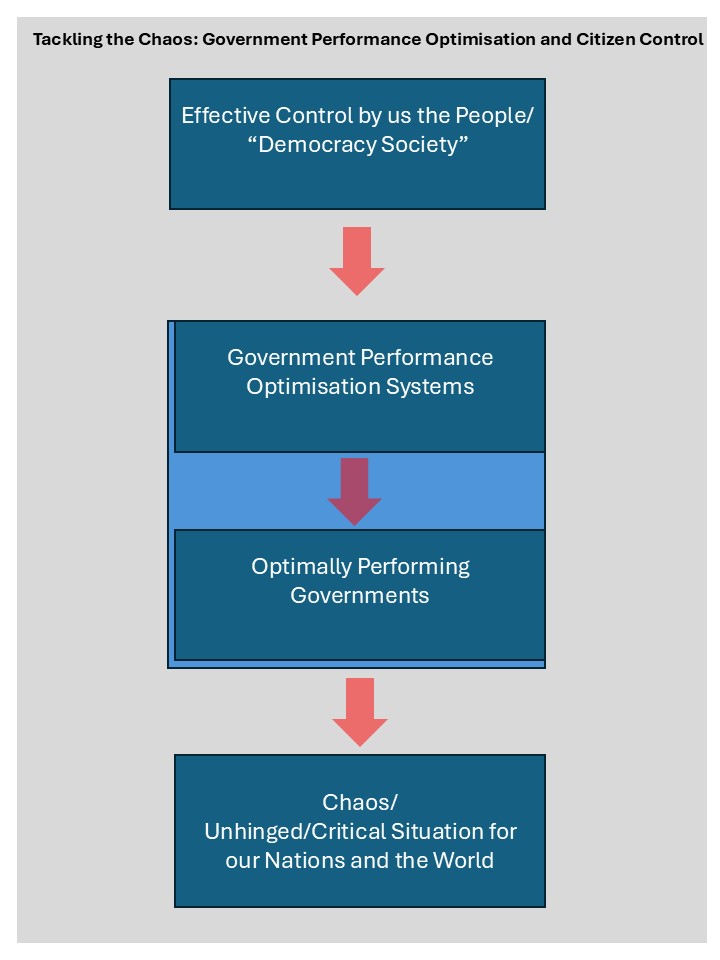
We can understand democracy as the backbone for society, and at the same time, its head, its steering system controlled by the people. When democracy dies, there is no functioning and accepted system to organise society. As a result, society descends into chaos and collapses.
Democracy at the abyss?
For us as citizens and our democracy initiatives this diagnosis means that by now our democracies and we as citizens are in an emergency. It also means that we cannot afford to waste time and energy with ineffective programs and actions anymore. We as citizens, together with our democracy initiatives, need to, now, without delay, design and implement a highly effective turn-around program to save and stabilise democracy. We now need an effective program ensuring that our democratic political system functions optimally, that people are content with it, identify with it, and support it.
The Reasons For the Ineffectiveness of Democracy Initiatives So Far
Why are democracy networks so far ineffective in their actions? Why are they failing so far to stabilise democracy, to make it work for the people and to create contentment with it?
One asset of democracy is the exchange of different backgrounds and perspectives to arrive at the best joint understanding of a problem situation and suitable solutions for a problem. From my perspective the reason for the ineffectiveness of existing democracy initiatives and networks appears to be that they lack the necessary analytical rigor to arrive at effective measures and programs for stabilising democracy and making it work for the people. Systemic problem structuring methodologies provide the yardstick for this understanding. They establish a clear connection between problem analysis, the necessary aims resulting from it, the factors affecting goal achievement and the shaping of the strategies necessary to achieve the specified aims.
Two examples from different nations highlight the deficits in the design of action programs by democracy initiatives. One is the presentation of the philosophy and actions proposed by a Democracy Network in a town in Germany. While initiatives such as the network are direly necessary to stop the demise of democracy and must be utterly welcomed, the approach of the network shows various shortcomings.
The first is that the organisation practically states nothing on its website about how they perceive the problem situation of democracy, be it in their town, their nation, or at another administrative level. The website indicates that they form a permanent round table for the strengthening of democracy ….”in their town”. This probably does not mean that they only want to deal with local democracy. But it needs to be made clearer evidently what exactly they are addressing.
Since there is no clear analysis of the problem situation, there is also no distinct description of their goals. As a result, the actions suggested by the round table sound fuzzy and unstructured. The round table aims to strengthen democracy “on the basis of the Constitution”. Why that, one wonders? Is there no discontentment in society with the performance of the democratic system as it is designed in the national Constitution? Do the democratic structures not need to be reviewed and possibly improved? The round table also wants to “make the democratic interconnection of society visible”. What is this concretely supposed to mean and achieve? And especially: How effective is this proposed measure in preventing the suggested or threatening collapse of democracy in Germany?
The web presentation of a national democracy network in another European nation, with hundreds of members organisations and individual supporters also reveals a severe lack of analytical stringency and rigour. The shortcoming reduces the effectiveness of the network in terms of saving and strengthening democracy practically towards zero. Most people in society will not be aware of the existence of the network, let alone of what it does.
In terms of the problem diagnosis concerning democracy the network writes: “Why we exist?…” Politics is at a crossroads. Our democratic institutions are facing significant challenges.” Compared to the assessment by Rafael Behr in the Guardian (“democracy running out of time to escape from the abyss”) these statements appear drastically understated and wrong. They do not at all reflect reality, the fact that democracy is at the abyss, in an existential crisis, subject to an “onslaught” as other observers write.
As far as the aims of the network are concerned, one then finds statements such as: “We support each other to connect and collaborate, share and learn”, to “build a way to agree ways forward”. This sounds like the network has a lot of time. The statements do, moreover, not provide any information on where exactly the “ways forward” are supposed to lead, and on what the ultimate aim or aims of the “connection, collaboration, sharing and learning” are supposed to be. Yes, all of these things are necessary, but where are they supposed to lead, what is their aim, and how much time does one have to achieve the aim? Somewhere we find that the network wants to “take action and influence decision makers together”. Again, we find no information on the areas in which they want to influence decision makers and what exactly they want to achieve with their action.
These are just two examples documenting the lack of methodology and analytical structure in designing effective strategies and actions. Such lack of analytical rigor might be a main cause for the ineffectiveness of democracy organisations around the world. (At the same time, in many nations the oppressive nature of governments in power is extremely hard to overcome, it may seem impossible.)
What Do We and Our Democracy Initiatives Need to Do to Become Effective – Now, With the Highest Degree of Urgency?
Problem Structuring Methodologies as the Foundation
What the shortcomings of the democracy initiatives and networks in structuring their approach highlights is their lack of capability to analyse and handle complexity effectively. They fail to define democracy and to analyse its interconnection with society correctly, they do not identify the factors affecting the performance of democracy. They lack the know-how and ability to solve complex problems effectively and efficiently. That problem is to some degree normal for humanity. As science puts it, our rationality is “bounded”.
The first step to overcome shortcomings in our analysis appears to be a matter of attitude. It is the acknowledgement of the complexity of the problem scenario surrounding the crisis of democracy and its interconnection with society, and the acknowledgement of the necessity to strive for utmost rational stringency in dealing with such complex problems.
Second, what we and our democracy initiatives need to know is that to overcome the limitation of our “bounded rationality” and to design effective problem solutions, we need to use so called “Problem Structuring Methodologies”. I personally find a book by Hans Ulrich and Gilbert Probst, two professors from St. Gallen University in Switzerland indispensable on this matter. Its title is “ Instruction for integrated thinking and action, a breviary for leaders.” (Unfortunately, so far available in German only.)[2] Democracy is government by the people, this means in democracy we are all leaders. If we want to lead and shape our democracies effectively, we need to understand such problem structuring methodologies.
Another valuable book in my view is “Rational Analysis for a Problematic World Revisited”, edited by Jonathan Rosenhead and John Mingers. The book presents various methodologies for dealing with complex problems. The title speaks to its utter relevance: In a highly problematic, and as it appears presently, even crazy world, we need “rational analysis” with the highest degree of urgency.[3]
The Concrete Steps Required to Ensure the Effectiveness of Democracy Initiatives
The problem-structuring methodology described by Ulrich and Probst appears to be most simple and straightforward. It suggests a detailed sequence of steps to create analytically sound and effective problem solutions. We here discuss the main steps necessary to arrive at effective action to save and strengthen our democracies.
Comprehensive consultation on and assessment of the problem situation.
Our own perspectives on the problems of our world and societies are naturally limited. The more perspectives we include in our analysis, the more likely it is, therefore, that we understand reality correctly. As far as democracy is concerned there seem to be perhaps three key problem issues. They would need to be discussed and confirmed by the Democracy Initiatives:
- Discontentment with democracies, the “political establishment” is high.
- A second problem, one cause for the first, is that democratic governments do not appear to have the capability required to solve critical policy issues for our nations effectively, such as poverty, inequality, and the lack of jobs. They do not seem capable of handling international migration adequately, to integrate “new citizens” effectively, they seem to be unable to lead their societies in times of huge global technological change effectively (example AI). They also are unable to provide an effective solution to a problem of existential relevance and urgency to humanity, the Climate Crisis.
If one were to suggest that solving these problems is impossible, then we must conclude that our governments fail to close the gap between expectations and feasible policy results effectively.
Finally, our governments fail in stabilising our democracies. In the US between 2022 and 2024, the Biden government implemented a “Presidential Initiative for Democratic Renewal” and organised an international “Summit for Democracy”, assigning a total USD 9.5 Billion to projects to “support democracy, human rights, and good governance globally”.[4]
Despite spending such huge amounts on these efforts, the Biden government failed to prevent US society from voting again for a politician who clearly lacks the qualities deemed necessary by the US founding fathers already, integrity and professional qualification, and to stop the decline of democracy around the world. In Germany the government has been dithering for years with what they call a “firewall” against a populist government and with the idea to have the party prohibited as “unconstitutional”. It has failed to come up with a constructive policy aimed at establishing and maintaining a cooperative and constructive democracy and society.
- A third aspect of our problem situation is that we and our democracies by now are in an utter emergency. For democracy, it does not seem five minutes before twelve, but nearly five minutes past twelve. In the US democracy is already being dismantled. In Europe it is at the abyss. In Germany people vote for a party which is considered utterly dangerous by large segments of the population and is in many comments equated to the NAZI party which dismantled German democracy and eliminated all forces working for a decent political system and society quasi overnight in 1933. Destructive forces from around the world evidently support the rise of this party. In the UK we just hear that two crypto-billionaires support the populist “Reform” party with a donation of a staggering total of GBP 72 million. For anybody interested in maintaining a decent functioning democracy serving the nation that must be considered an onslaught on democracy. (In connection with the announced donations to Reform, reports in the Guardian and by the BBC are of interest describing how Bitcoin-billionaires from around the world aim to create political systems in which the wealth of an individual person measured in bitcoins determines the voting rights and in which taxes to help the poor are considered an infringement on the liberty of wealthy people.) [5]
What kind of strategy do we, citizens and democracy initiatives, put against such a concerted attack ? How do we come up with an effective strategy to defend and maintain a humane, decent and effective democracy serving society in our nations and the world?
What Exactly Is Democracy?
Analysing what precisely we are dealing with, is a necessary element of our problem analysis.
If we talk to people, we will notice that many will not have an idea what democracy is at all. Those who have, will mostly have different understandings, even from one person to the next. One reason why our efforts for making democracy work fail, is that also our democracy organisations do not have an agreed and clear understanding of what the object we are working on is at all, what elements it consists of, and how democracy can and must be configured and operate for it to produce the results our societies and our world require.
To get a better understanding of what exactly is necessary to stop their decline, we here suggest basing our understanding of what democracy is on the established term “political system”. But what does a “political system” do exactly? What is its precise purpose?
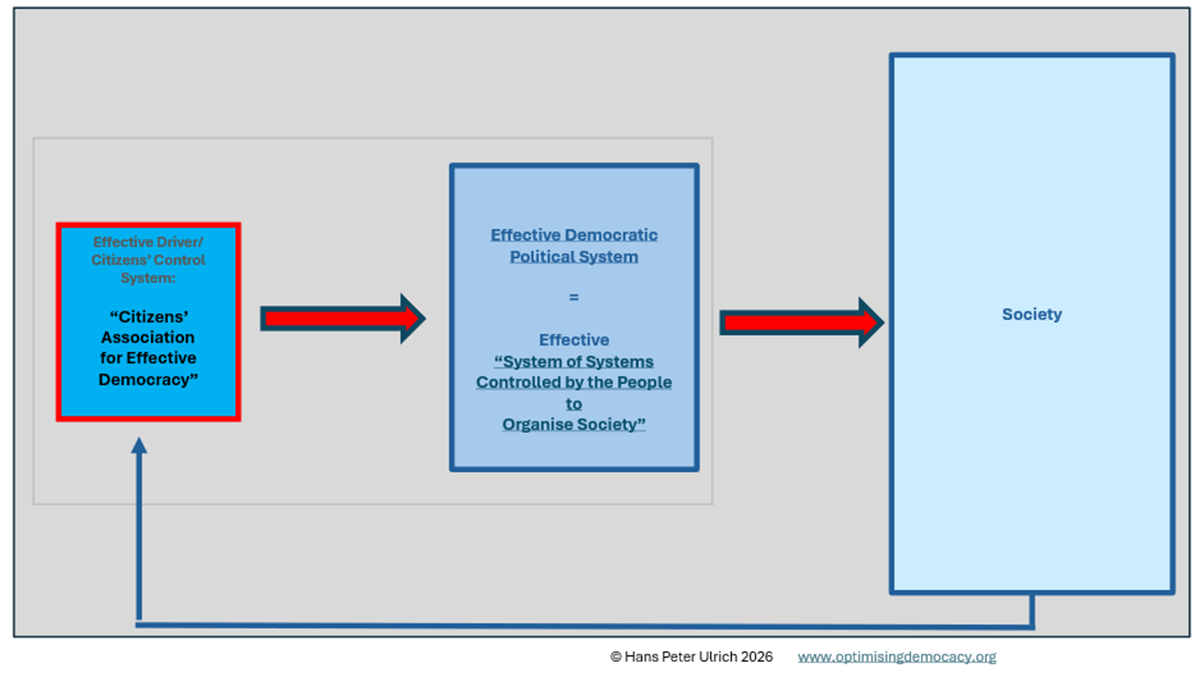
Society requires a “system to organise and to steer society” and we suggest this as a more concise definition of democracy. At the same time from a “technical perspective”, our democratic system, like our bodies, is a system of many systems. Among other elements, it requires a system for discussing and deciding what kind of society we want to have, it requires systems to identify, weigh and manage political issues, systems for strategy making, decision making and implementation. It also requires a system for selecting leaders of integrity and quality. What makes this system for “organising and steering society” a “democracy”, is the fact that it is (or at least supposed to be) controlled by the people. If the political system is not controlled effectively by wider society, but by a “political elite” of some kind, then the system is not really a democracy.
Understanding democracy simply as “decision making on the basis of majority” falls far short of what we as a society need and require, “optimal solutions” for our political problems. To get to solutions of such quality, we first need highly sophisticated systems to research and generate different options for solving these problems within our democratic systems. Then we need effective decision-making processes, then effective implementation systems.
One reason why our endeavours for strengthening and stabilising democracy have failed so far, is because we have not understood that in a technical sense democracy is a “system” of systems for organising and steering society whose function we as the people must optimise and control.
Comprehensive Consultation On the Necessary Aims of Our Actions
The next step following a detailed analysis of the problem situation will be the identification and verification of the necessary goals resulting from the problem analysis.
We suggest the above problem analysis leads to the following overall aims:
- The aim and need to instantly stop and reverse the decline of our democracies.
- The aim to make our democratic political systems effective and efficient in solving the complex problems which our nations and our world are facing.
Ultimately, our well-being depends on the effectiveness of our democratic systems at all administrative levels, local, regional or state levels, national or federal levels, supra-national levels, like the EU, and even on sound democratic structures of policy making at the global level. We as a global society evidently have to decide on how far we want to develop a technology like AI, deemed dangerous for humanity now even by its developers. We need to aim to make democracy at all levels of society effective. For the time being, the most important and influential levels in our world seem to be the democratic systems at the national level. On these we must focus our attention. They will help to make democratic structures at other levels of our political system effective.
- A third aim will have to be to create identification with, support for, and contentment with the overhauled democratic systems in our societies.
Analysis Of the Factors Influencing Goal Achievement
Factors of relevance for the aim of “instantly stopping and reversing the decline of our democratic systems”.
We suggest a necessary factor to achieve this goal is the instant design and implementation of an effective democratic “turn-around” program in our nations. One key aim of the program must be to convince the people that they need to stop voting for politicians who lack the necessary integrity and professional qualifications for leading our nations and that, instead of voting for populist and dangerous politicians, all citizens wanting to serve their nations without delay need to engage in joint efforts to build highly effective and efficient democratic policy making systems capable to cope with the huge challenges for our nations and our world. We need to create the understanding that effective cooperation in society, fostered by a functioning joint democratic system, will be the best way forward to cope with those challenges.
Evidently, to build and implement such a turn-around program in our nations, we need people capable to design and implement such a programme. So far, our heads-of-states evidently lack the necessary qualification as the dithering of the German government with a “firewall” against and with a legal prohibition of the populist AfD party shows. The government appears to lack the ability to communicate constructively with the people and to convince them of the steps necessary to create an effective democratic political system.
Since governments lack the understanding of the need for such a turn-around program and the know-how for implementing it, we, the people interested in a functioning democracy and our Democracy Initiatives, therefore, must urgently join forces to design such an effective turn-around programme and to ensure that “someone”, ideally the head-of-government given the lack of an effective citizen control system over democracy so far, implements it.
Factors of relevance for achieving the goal of making our democratic political systems as effective and efficient as possible.
We suggest that a consultation on these factors will identify the following factors as relevant for the performance of our democratic political systems:
- The integrity and professional qualification of our politicians and civil servants.
- The optimal functioning of all processes and systems in the political system, from the processes for selecting politicians of the qualities required, to the processes for strategy making, decision making, policy implementation, and evaluation.
- One critical system of relevance for the performance of our political system is effective communication between us, the citizens, as the highest sovereign in the democratic nation, and our policy making system/government. There must be effective communication processes between us as citizens and our governments about our needs and expectations towards the system, and the possibilities of the system for achieving the aims specified by us.
- The most decisive system for the performance of our democratic political system is effective control, by us, the citizens, as the stakeholder behind the democratic system. As Systems Thinking tells us, no systems works effectively without effective control by the stakeholder behind it. If our democratic systems do not perform effectively so far, the key reason appears to be the lack of effective control by us, the citizens, over it. Parliaments and elections do not ensure the optimal performance of our democratic systems. Our parliaments allow our governments to fail and do not correct the causes for their failure.
- Finally, our democratic policy making systems need adequate resources to be able to comply with our needs and expectations in as much as only possible. In a complex world undergoing substantial changes including those in technological areas, we need extremely powerful democratic problem-solving systems. For them to be effective, we, the people, need to equip our democratic governments with substantial amounts of resources. Failing to do so is likely to weaken and to possibly even destroy society.
Factors of relevance for creating identification with, contentment with and support for decent and effective democratic systems.
We suggest these factors are:
- The optimal functioning of democracy as specified under the above aim.
- A sound understanding by the people of what democracy is, how it functions or must function, what their role as “equal citizens” in a democracy must be, and what they can reasonably expect from their democratic political system and government.
- Basically, for the people to support democracy, the people must fully understand and support the dictum by Churchill that “ democracy is the worst form of Government except for all those other forms that have been tried from time to time.…’ Democracy may not be perfect, but it is still the best form of government, both in terms of securing the rights of the people and in terms of performance, if it uses the know-how distributed in society effectively for solving the political problems it is facing.
- To ensure that people have this understanding, we and our democracy initiatives must now ensure with utter urgency that our nations get “citizenship education systems” of the highest quality to ensure people understand what democracy is, how it must be configured and function, and what they must in their role as citizens do to make it work optimally for society.
Saving our democracies, making them effective, creating contentment with and support for them in society will then require the design of strategies incorporating all aspects of relevance for the achievement of the three aims suggested and implementing these strategies.
Identification Of the Possibilities for Us to Take the Necessary Corrective Action
But how can we as citizens, how can our democracy initiatives and networks ensure that the necessary turn-around programme is implemented? How can we ensure that the necessary preconditions for the effective performance of our democratic political systems are in place? Evidently, politicians who lack the necessary integrity and quality will not be inclined to make themselves redundant. If this is so, how can we as the people ensure that we get politicians of the necessary quality? Working with the politicians we presently have, how can we ensure they get the necessary qualifications and design and implement sound policies? How can we ensure that all other preconditions for the effectiveness of our democratic political systems are met?
The first step for us to take corrective action is to understand democracy as what we defined it above, a system of systems controlled by the people for organising and steering society. The second precondition is for us to understand which factors determine the performance of the system. The third is to put these into place.
To be able to do this, we as citizen and our Democracy Initiatives need to exert effective control over our democratic political systems. To establish effective control over our democratic systems, we need to put the pre-conditions for effective control in place: we need to assemble know-how, resources, and power. Concretely, if our democracy initiatives want to stop the decline of democracy, turn-it around and make democracy as effective and efficient as conceivable, they must join their efforts. They must develop the necessary concepts for turning around the decline of democracy and for making it effective. They must communicate the necessary actions to stop the decile of democracy to our governments. Since democracy is the government by all of us, we, the citizens must support and join their activities, so they have the required power and resources to succeed.
Conclusion
Democracy in the world is at the abyss; it is under assault. The dystopia of a chaotic and inhumane world controlled by vain, erratic, power-hungry dictators who enrich themselves at the expense of wider society and lead unnecessary wars harming all humanity is looming over us.
To prevent democracy from collapsing and to strengthen it, democracy initiatives around the world must aim to exert effective control over the democratic political system on behalf of and together with the people. They must analyse the problem situation in detail, identify the necessary aims, the factors affecting the achievement of the goals, and develop and implement effective strategies focussing their energy and resources on the decisive parameters for achieving the necessary goals.
To achieve the necessary influence over the political system the democracy initiatives and networks must aim to join their resources and power. Since democracy is government by us, the people, and we all are responsible to maintain it and to make it work, we as citizens must all join the Democracy Initiatives and Networks and support their endeavours.
[1] European democracies are running out of time to turn away from the abyss | Rafael Behr | The Guardian
[2] Hans Ulrich, Gilbert J.B. Probst, Anleitung zum ganzheitlichen Denken und Handeln, Ein Brevier für Fuehrungskraefte („Instruction for integrated thinking and action, a breviary for leaders“), Haupt, Bern and Stuttgart, 1991
[3] Jonathan Rosenhead and John Mingers, editors, Rational Analysis for a Problematic World Revisited, Problem Structuring Methods for Complexity, Uncertainty and Conflict, Second Edition, Wiley, 2001.
[4][4] FACT SHEET: The Biden-Harris Administration’s Abiding Commitment to Democratic Renewal at Home and Abroad | The White House
[5][5] https://www.theguardian.com/tv-and-radio/2026/jul/12/the-tech-billionaire-takeover-review-a-surprisingly-fun-look-at-the-crypto-bros-threatening-democracy Review and Meet the crypto billionaires building a world where money buys you a vote – BBC News