An assessment and a proposal
Where do we go from here? How do we move towards constructive steps? And how do other people feel about the outcome of the meeting?
Yes, on the positive side, what was great and encouraging about our democracy meeting last week, was that it offered the possibility to meet so many people concerned about democracy, about the fate of society and the world, people with different approaches to working on democracy. It is amazing that some attendants had even travelled hundreds of miles to take part. This shows that there is a dire need for constructive exchange. I wonder whether these people think their efforts were worth their while.
On the negative side it was again an utterly frustrating meeting, costing energy, and leading to no tangible results, while democracy in our nations and the world appears to be in an increasingly bad state.
The meeting had been termed by the organiser as a “strategic collider”. And yes, finding an effective approach to solving the problems of our democracies appears to require the frank exchange of different perspectives on the matter. Asked about our views at the outset of the meeting, I had, therefore, reluctantly suggested that the problems surrounding society, democracy, and the state of the world were so complex that our efforts would lead to nothing unless we would aim for highly structured thinking and apply what is known as “Systemic Problem Structuring Methodologies”.
To me society is an organism in which we all (can) benefit from the impulses we provide to each other. So many people are offended by “opinions”, but ultimately it is not the opinion what counts, but reality. The question is whether we see reality correctly and whether we are ready to learn from it. One advantage of democracy is the possibility for the exchange of perspectives it offers. My perspective on the outcome of the meeting is that it proved the point: It did not lead to any tangible results, because it was completely unstructured.
The basic steps necessary for result oriented problem solving, which the mentioned problem structuring methods suggest, are:
- Creation of a joint understanding of the problem situation: “What’s the problem?” This is how LSE professor Jonathan Rosenhead pinpoints the essence of this necessary first step in the problem-solving process.
- Identify a joint goal of action based on a joint understanding of the problem situation.
- Identify all factors and developments affecting the achievement of the joint goal.
- Design and implement strategies incorporating all these factors, at least the most relevant ones.
Measured against the yardstick of these logically necessary problem-solving steps, the meeting was highly unstructured, like so many democracy events and initiatives. One problem appears to be that our minds are not naturally made for structured problem solving. We need tools to help us in designing sound solutions. (In preparation for the meeting the organiser and I had discussed the fundamental principles suggested by the problem structuring methodologies already. But for a “systemic mode of thinking” to sink in appears to require more time.)
After a time of informal conversation allowing to get to know each other, the official part of the meeting began with a lengthy introduction of himself, valuable to get to know a person, but which did nothing to define the problem we were supposed to be dealing with.
The organisers then implemented all kinds of “fancy” ideas about how to run the event, such as taking photographs of each other, writing one single question of personal interest on a sticky note. Then somehow the fifty or so participants were split up in groups to discuss certain questions which appeared to be more or less randomly selected. Barely had the table groups started to grasp the topic and began the conversation, when the members were asked to change tables to join another conversation. A participant confirmed the observation that this process was evidently ineffective by stating that in his personal field of engagement in democracy he regularly encountered the same problems.
Another part of the meeting then started in which participants were asked to declare which topic they would like to discuss. Those interested in the mentioned topic were asked to form a discussion group with that person.
At some point in these debates, I suggested as sort of a hypothesis to one participant that we needed a new citizens’ organisation in our political system, a “Citizens’ Association for Effective Democracy”. He, running a democracy organisation, replied with the question, whether there were not already enough organisations of that kind around, to which I suggested that they were not effective. To establish whether my claim was correct, further specific debate would be required on the issue how we could measure the effectiveness of democracy organisations. Unfortunately, the evening did not leave any room for clarifying such a crucial issue. More time is required.
Another participant had declared her interest to discuss how to get more “deliberative” and “participatory” elements included in our democracies. From my perspective, movements demanding this, have been around for decades and not generated any progress. One reason to me from the yardstick of “structured problem solving” appears to be that those concepts are fuzzy. A newspaper article this week suggested that democracy was a “space for deliberation” (not one for Elon Musk’s algorithms, article in the New York Times). “Space for deliberation”? The term reveals the problem: If we “deliberate”, then it cannot be in an unstructured “space”. To generate results, we must deliberate on clearly defined issues, and the deliberation must be structured in such a way that it leads to concrete results, ideally to the “best” solution for a given problem. Of course, we must deliberate on what “best” in the context of democracy would mean.
Also the demand for “participation” must be specified for it to be able to make a constructive contribution to the solution of the problems of society and the world. Systems Thinking tells us that the purpose of our endeavours must be precisely defined for them to generate satisfactory results. I failed to get this message across in the short exchange on deliberation and participation. Matters are complex. The well-known formula proposed by my discussion partner “to agree that we disagree” from my perspective does not hold: We seem to need to agree with great urgency on suitable and effective measures to make democracy work.
Proposal for Joint Steps Forward
- On the necessity to make our democratic government systems perform as effectively and efficiently as possible
“What’s the problem?” That question appears to be the necessary starting point for our endeavours.
From my perspective the overall and most pressing problem concerning democracy and society is that the situation of our nations and the world is becoming increasingly difficult and desperate.
While we would need highly effective democratic “leadership systems” to cope with the problems of our societies and our world, they fail. US democracy has decayed into an utter mess harming the people in the US and the world. Governments in other democracies do not seem very effective either. Discontent with government performance is high in many democracies. The UK government has been committing severe blunders over many decades as Anthony King and Ivor Crewe describe in their book “The blunders of our governments”.
Presently the most disturbing and evident failures of the UK government appear to be the “Water Crisis”, the failure to set up a water treatment system which does not pollute much of the British environment and operates at an adequate price for the citizens. Then there is the “fly-tipping” crisis, in England alone around 1.2 million of fly-tipping events per year, costing the taxpayer hundreds of millions of pounds per annum and causing great harm to the environment and people in England (in addition to the water pollution crisis). What makes the “fly-tipping” crisis even more disconcerting is that it could be understood as a first symptom for a society in disintegration, in which people partly for reasons of egotism and greed for profit do not care about others and the “common wealth”, they harm society, and this in a time when society definitely cannot afford to waste funds and needs to co-operate to the greatest extent possible to remain sound and healthy.
A third government failure discovered more recently and indicating that there is something severely wrong with the overall performance of the government system is the “Post-Office Scandal”. If we understand the task of a democratic government as supporting the well-being of society and of citizens, then this case is especially appalling, because here rather than supporting the well-being of people, government itself destroyed the livelihood of a thousand or more people through its ineffective organisational structures.
Democracy is government by the people.
It is a privilege for which people have fought thousands of years. But it also is an obligation. It means that we as the citizens ourselves are responsible for the way government operates.
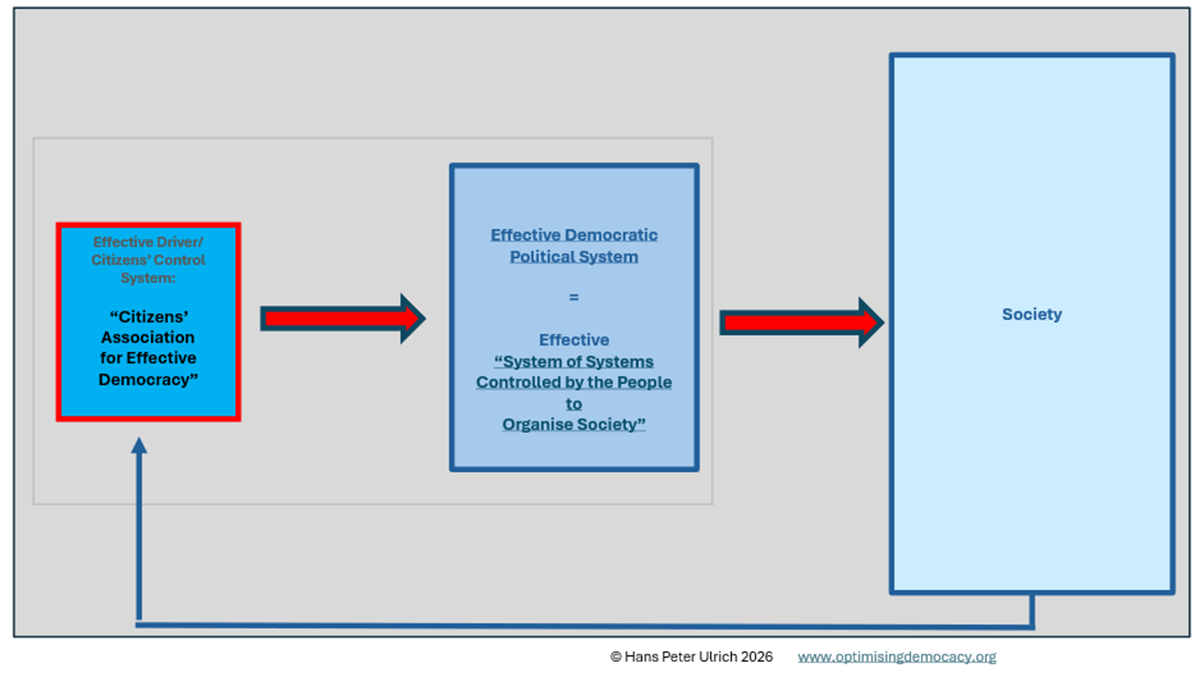
Systemic thinking tells us that no system works effectively unless it is controlled effectively by the stakeholder behind the system. What this means is that for our democratic political system, for our governments to work effectively, we as citizens need to take the initiative and form an effective driver to make our democratic governments effective. Concretely: We need a “Citizens’ Association for Effective Democracy”.
The logic is clear: History has always developed and, from time to time, exposed humanity to huge challenges. If we want to be able to deal effectively with the challenges of our time and age we need highly effective democratic political systems, more concretely highly effective democratic governments. To get such effective governments we as citizens must form them and supervise their work. Effective democratic steering systems are crucial for the survival of us as human beings and for the survival of our societies. If we as citizens do not understand the privilege democracy offers us and if we do not make our democratic political systems effective, then we and the world are (perhaps or probably – what is your assessment?) entering a time of serious chaos and destruction, for various reasons far more destructive than at any time in the history of humanity.
Figure: The Need for a “Citizens’ Association for Effective Democracy”
What’s the problem?
In my understanding our central problem is that we lack democratic governments capable to deal with the gigantic problems of our world. This lack of effective democratic government systems threatens our societies and the world in an existential fashion.
What needs to happen?
From my perspective, we need to join forces around this understanding of our situation and discuss how we can ensure that our democratic political systems and especially our democratic governments operate as effectively and efficiently as possible.
If we do not join forces and do not make our government systems effective, then our societies and our world will be in great trouble.
Can we agree on this view of our problem situation? What is your perspective on democracy, society and the world and on what needs to happen to maintain our societies and the world in a “decent state”? We need to discuss and clarify these issues urgently to move to concrete and effective measures.
- On the need to learn about “Systemic Problem Structuring Methodologies”
Diversity is beautiful. And that so many people approach the problems of society and democracy from their own angles is enriching. Diversity, participation, deliberation, the human factor, community building, data driven attempts to enhance strategy and decision-making in democracy, citizenship education. All of this is highly valuable.
From my perspective all of these aspects appear to be elements in a puzzle describing our democracies and our societies, our world.
One element in our puzzle must be the systems and processes with which we organise society and our world, the ways and means with which we find effective solutions fulfilling our aims and needs in the most satisfactory way for everyone possible. To find solutions we must understand in which way the elements are interconnected and which effects they exert on each other. One crucial step in finding a solution appears to find the driving force in the puzzle, the central element driving the solution.
The reason why our efforts in creating better democracies and better societies seem to fail so far is our inability or unwillingness to deal adequately with this complexity. We make our politicians responsible for our problems instead of seeing that the privilege of democracy means that we ourselves are the cause of the problem. We fail to make our government systems effective and to select politicians who have the necessary integrity to run our nations and the professional qualifications to make huge government machineries work effectively.
Understanding complexity is a crucial element in our puzzle. Scientists have put much thought into devising methodologies how we can better handle complexity and come to effective problem solutions in complex environments.
To solve the complex problems of our nations and our world we need to study these methodologies. To get to effective solutions we need to identify the very best methodologies for problem structuring and problem solving. This includes methodologies for weighing preferences and for decision making in societies in which people have at least party different or even opposing preferences.
A major reason why our efforts for making democracy work do not generate the necessary results so far appears to be that our efforts and endeavours do not comply with structural necessities.
Our ability to solve complex problems is a foundation for the success of a society and for humanity as a whole. For society to become better at problem solving we all need to learn about methods for structured problem solving. Creativity, developing our own ideas and approaches, is good. But to verify the rationality and the value of our concepts we need to check them against these methods. From my perspective (and the perspective of the authors) everyone in policy making needs to understand and apply methodologies for systemic problem structuring in their work, so solutions are feasible. I suggest that we need to train every politician in systemic problem structuring methodologies. It is of decisive importance for our societies that we discuss and evaluate this proposal.
The two books I recommended in the meeting as an introduction to problem structuring methodologies are:
- Rational Analysis for a Problematic World Revisited, Problem Structuring Methods for Complexity, Uncertainty, and Conflict, Edited by Jonathan Rosenhead and John Mingers, 2001
And:
- Hans Ulrich, Gilbert J.B. Probst, Anleitung zum ganzheitlichen Denken und Handeln, Ein Brevier für Fuehrungskraefte, („Introduction to holistic thinking and action – a breviary for leaders“) Haupt, Bern and Stuttgart, 1991. The book so far seems available only in German. In my view it urgently needs to be translated into English. The book appears to be of fundamental value to every policy maker and person concerned with politics.
And then there is a shorter article with the mentioned crisp and concise title:
- “What’s the Problem? An Introduction to Problem Structuring Methods”, by Jonathan Rosenhead, Interfaces 26(6):117-131, December 1996, DOI:10.1287/inte.26.6.117
These publications take a lot of time to read and digest. For those who do not have the time to engage with them it seems sensible to begin with the four steps to effective problem structuring described above:
- What’s the problem? Create agreement on the understanding of a problem situation
- Identify a joint goal
- Identify all aspects relevant for goal achievement
- Design strategies which incorporate all or at least the most relevant aspects for goal achievement.
One problem standing in the way of an effective way forward is that people appear to have their own views and pet projects in mind for the way forward in saving our democracies or strengthening them. The problem appears to be is that if these views and projects do not yield to the rational principles described by these methodologies then they will lead nowhere and must fail. Joint projects must be based in structural logic for them to be convincing and effective.
Conclusion
If we want to solve the problems of our societies and our world, we urgently need to engage in creating effective democratic government systems. Our next meeting ought to focus on how we can achieve this aim.
Systems Thinking suggests that we need an effective driver, a “Citizens’ Association for Effective Democracy”, if we want to make our democratic political systems effective.
To move forward, we need to assess the rationale behind these suggestions in more detail. We need to discuss how we can create such an Association and what its detailed tasks must be.
On a general note
To solve the problems in their societies people in any democratic nation need to think about how to make their democratic government systems as effective as possible.
Our world desperately needs effective democracies which cooperate in dealing with the problems of our world and societies. To get there, we now need to create “Citizens’ Associations for Effective Democracy” in all democratic nations.
All in all, for some the above thoughts on structure and effectiveness might appear too mechanistic.
We need in fact the human element in our world, our world would be terrible, if we would all be rational machines only.
But then, to maintain our nations and the world in a humane state and to organise the lives of millions or billions of people in a cooperative and productive manner, we need effective forms of organisation, and rationality.
Our world needs both: most of all humanity – and rationality.

