Tag Archives: Citizen Control

Unhinged: A situation of chaos in the world

What our governments and we ourselves must now do to have a chance to cope effectively with the situation.

Presently there seems to be great chaos in the world. People everywhere are depressed about what is going on. Everything is enormously complex. It is difficult for us to identify and agree on the necessary steps forward. Also our governments seem overburdened.

How do we get out of the chaos?

It appears that the guiding principle must be to look for the key parameters driving the solution.

I suggest there are two such parameters: First, the optimal performance of our governments, and second, more decisively even, our effective control as citizens over our governments.

I. Our governments must optimise their performance.

Our governments are the systems, the tools, and the institutions, with which we as societies, national or even as global society, develop, and implement the solutions for our political problems.

A key step for us is to recognise that we only then stand a chance to solve the extremely complex problems which our societies and the world are facing, if our problem-solving systems, our governments, are working optimally.

This means that our heads-of-government, must now optimise the performance of the governments, which they lead for us, they must as soon as possible introduce a “Government Performance Optimisation System”.

Answering the question, how to govern optimally, cannot depend, however, on the personal whims and convictions of a single person or a limited group of persons. The optimisation of government performance rather necessitates taking recourse to all know-how distributed in the nation and the world. To ensure the optimisation of government performance heads-of-government must arrange for an open and comprehensive consultation with society on the issue and implement its conclusions.

II. We, the citizens, must exert effective control over government.

Since governments will either not be aware about such fundamental suggestions on their performance – there is  a huge amount of information out there for them to digest – , or they will simply ignore them, perhaps because they are overwhelmed by the day-to-day necessities of governing, it is indispensable that we as the citizens realise that democracy is “government by us, the people”.
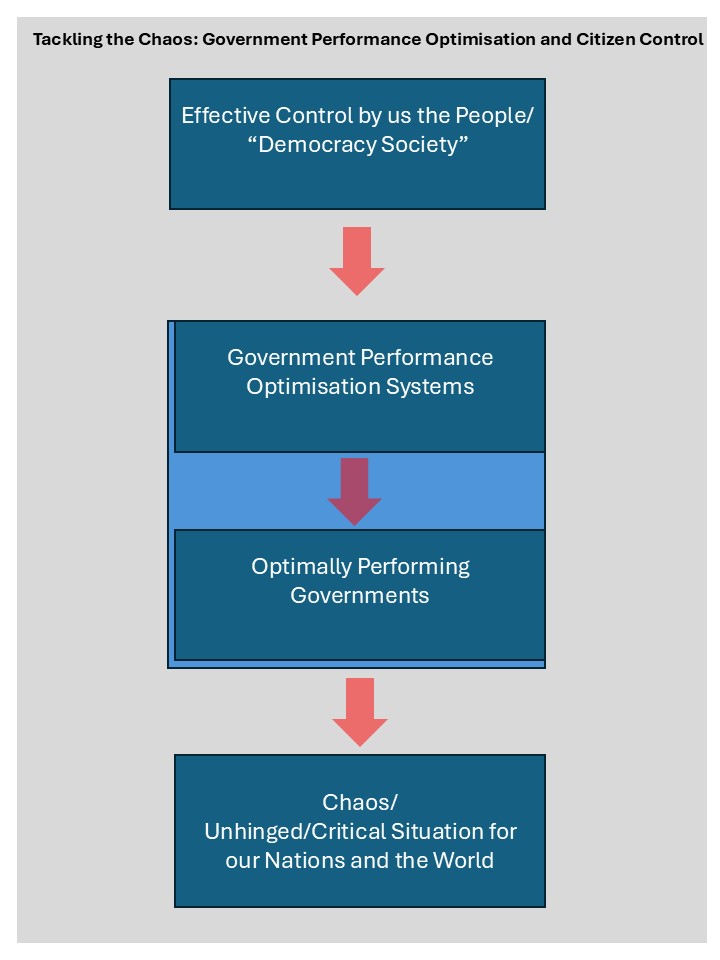
This is a privilege and a responsibility. “Government by the people” means that we, as the people, must exert effective “control” over the systems with which we govern, it means that we need to ensure that our governments operate as effectively and efficiently as only possible. Concretely, we must ensure that our governments establish the required “Government Performance Optimisation System”.

Of course, we as individuals largely have no say in the work of governments. For us to exert effective control over our government and to ensure that government operates optimally requires joining forces and resources. Concretely this means we must create and join a “Democracy Society” in our nations.

Participating in elections every four years or so or even not-participating in them at all does not suffice or measure up. Maintaining a functioning society and a functioning democracy rather requires active citizenship. We need to get together once a week, perhaps a Friday afternoon, and consult about how to build and maintain functioning societies and democracies. Together we need to assemble the optimal know-how on how to ensure the optimal functioning of our democratic governments. Since government is “all about systems”, systemic problem structuring methodologies appear to be a precondition for getting to sound results.

Conclusion

Of course there are many more detailed issues to tackle on how to ensure the optimal performance of our government systems. Clearly, to achieve this goal, our politicians must be qualified “optimally” (we need to define what this means and create suitable systems to ensure they have the require qualifications). Moreover, all systems and processes in the government must function optimally as well, such as strategy and decision making, implementation, communication with the citizens, and many others.

Concretely we desperately also need effective Citizenship Education Systems, one issue our governments fail in addressing in perhaps all democracies, a failure which seems to be responsible to a large degree for the problems of our democracies.   

At the same time there is no use in submitting proposals in the public debate when we do not have effective systems in place for the assessment of such proposals and for making sure they are implemented if deemed beneficial.  For this we clearly need the proposed “Democracy Societies” in our nations.

Certainly, depending on their state, in some nations it will be more difficult than in others to implement the proposals made here. If society is suppressed by the rulers it might be impossible, at least for now.

In any case, for us to deal effectively with the huge challenges our world is facing, we need optimally functioning governments.

It seems that our governments would be obliged to install effective Government Performance Optimisation Systems now, without delay, if they do not want to be responsible for the collapse of our democracies and the world.

In our critical situation it appears necessary that we rethink our role as citizens in our society. It appears to be our responsibility as citizens to make sure that our governments perform optimally. The indispensable starting point appears to be to get together on a regular basis to discuss and clarify how to move forward to an effective solution for the chaos in our world.

Getting order into Number 10

A rational systemic approach is urgently required to make UK government perform as effectively and efficiently as possible.

What kind of system is government really? What exactly is its purpose? How to structure government best, so it serves the nation and the people best? How to make government perform optimally? How to set up an effective Government Performance Management System?

The UK government, generally speaking, is responsible for protecting and enhancing the wellbeing of around seventy million people. That is a huge and daunting task in our complex and challenging world.

As a consequence, when someone is entrusted with running government, they are obliged to ensure they do their job properly, or better even, optimally. Every degree in performance of the government will affect the lives of seventy million people in one way or another. The failure to get the job right can ruin the well-being of people and ultimately destabilise and destroy the entire nation.

Presently, only three months into the new Labour government, news have leaked out about infighting and chaos in Downing Street. Now ministers are calling for Keir Starmer “to get a grip of Number 10”. [1]

What the chaos shows is that a convincing rationale is missing for making Number 10 work. That is devastating for the nation. If the “head office” of government is not working properly, the entire government machinery won’t.

So, what exactly must Keir Starmer do, to bring order into number 10 and to make government perform optimally?

Systems Thinking provides a rational and transparent approach to answer this question.

A system is shaped by its purpose. So, the first thing Starmer, like any responsible head-of-government in our world, must ask is: What exactly is the purpose of “a” or “our” government system?

Systems Thinking also tells us how to get to the best answer to this initial question and to finding the solution to the overall problem of making government as effective and efficient as possible. It is by using all know-how distributed in society, and ideally in the world, through comprehensive research and consultation with the people. One of the fundamental typical mistakes in British government is that it is run by a narrow “boys’ club”, by people who consider government their private turf and think they personally know best how to run it. Most  governments on earth suffer from this fault in one or another way.  The attitude has caused much harm to the British nation. Not to engage in comprehensive consultation on how to structure and run government optimally at the beginning of one’s time in office, or ideally beforehand, amounts to negligence towards the seventy million inhabitants of the UK. Since the world depends on effective and efficient governments and leadership, not optimising government performance amounts, moreover, to negligence towards the entire world.

So let us assume for now the consultation on the exact purpose of the government system were to conclude: The purpose of governing is the identification, weighing, and the management of public issues in the most effective and efficient manner possible, so that the work of government maximises the wellbeing of the British population, today and in the future.

This definition tells us that our government system requires four fundamental sub-systems: One sub-system to make government perform in the “most effective and efficient way possible”, one sub-system to identify public issues, one sub-system to weigh and prioritise them, and one sub-system to manage them.

Systems and sub-systems are organisational units. They must translate into the organisation chart of government. Presently you will probably not find these four sub-systems on the first sub-level on line two of the organisation chart of the British government. This is a key reason why government cannot work optimally and will commit blunders. Evidently, if you do not have an effective system to make government performance as effective and efficient as only conceivable or, in other words, to “optimise government performance”,  then you will probably not have a government capable to handle the extremely difficult political problems of our time adequately. Government will fail, disappoint voters, it will not be trusted and get into trouble, by the latest at the next election. Moreover, you will undermine trust in democracy altogether, you might cause discontent and riots.  

What structuring government work in a rational, systemic way allows concerning the relationship to the public is to make government work absolutely transparent. It allows you as a head of government to lay your books open and to inform the people: This is how we optimise government performance. You can, moreover, involve the people in shaping government and tell them: This is your government. If you have a better proposal for optimising government work, please let us know. You can precisely show:  This is how we identify public issues, this is how we weigh them, this is how we manage them. You can again involve the people by stating: If you have proposals how we can improve the performance of these systems, let us know. We will examine your proposal and feed it into our open consultation process on government optimisation.

Each of the initial four sub-systems will have many sub-systems on their own. The system for “managing” public issues, for example, will require a sub-system for strategy making, one for strategy implementation, and one for evaluation. The system for strategy making itself will require a system which identifies and confirms the exact goal of each policy, a system which identifies all factors affecting the achievement of the goal specified, and a system which builds strategies which incorporate all factors of relevance identified. If one omits any factors of relevance, the policy will not work, and resources will be squandered.

As regards the concrete identification of policy issues, one policy issue which is probably never properly recognised is the specific task of “stabilising UK democracy”. In a time when all democracies are threatened by populist tendencies and are at danger of sliding into destructive dictatorships, the issue of “stabilising democracy” is of critical importance for the nation, like for any democratic state.

How to stabilise UK democracy? One key factor would be to create contentment with it. To achieve this goal, one would have to make UK democracy work optimally, meaning concretely that one would need “a system to make UK democracy work optimally”. But making a machine work optimally alone does not suffice to create contentment. One would also have to communicate to the client, how exactly the machine is constructed and why its way of construction would be optimal, so people really see that their democratic system is the best they can get. What this requirement tells us that we need an effective system of communication with the citizens. We also need an effective citizenship education system to maintain the stability of democracy and to avoid that people are being misled by populists. What is the present state of the UK citizenship education system? Does it comply with the requirements? We would need to check, but it is highly unlikely.

While the individual lay-out of each system and sub-system largely depends on its specific purpose, all systems must have two effective standard systems for them to function properly: Effective control and effective communication. No system works effectively without effective control, and all system needs effective communication systems, both inside the system and with stakeholders on their outside. In case of government those stakeholders are primarily the people. How to set up effective control and effective communication? It will again depend on identifying all aspects which influence effective control and communication and on incorporating all relevant factors into the system.

For us as citizens it is important that democracy is “government by the people”. This means that it is ultimately our responsibility to make democracy and government, as its key part, work. We must set up an effective chain of control from us, over our control institutions, to the head-of-government, and to ultimately all policy making units. Presently Parliament and House of Lords are our key “control systems” over government work. Do they function effectively as control systems? If members of the House of Lords give presents to government, at worst they might do this to bribe government, at best they might simply be more like friends to members of the government. In any case, they will not be acting properly as “controllers” on behalf of the people and unlikely to control government work effectively.  Yet, if our control systems do not work, we cannot be astonished if we are not content with the work of government.

How can we set-up effective control over government? Systems Thinking tells us that, we, the people, need to form a driver to achieve this goal, an organisation which deals with the question of “how to set up an effective democracy and an effective government”. Without the people forming a driver, an organisation which deals with the question of how to optimise democracy and government performance, we will not get an effective democratic system, and we will not have a government which performs optimally.

But back to government itself. What must Keir Starmer now do to ensure his government works optimally?

I suggest he now needs to do two things: First, he must ensure that government runs optimally on the basis of its present organisational set-up, and, second, he must set up a system which develops a new government structure on the basis of Systems Thinking, a structure which optimises government performance. For these tasks the Prime Minister needs to hire two persons: One person familiar with present government operations who ensures government works as smoothly and efficiently as possible on the basis of its current organisational structure, and one person whose task it is to optimise government performance. For the task he or she needs to understand Systems Thinking and to set-up an effective “Government Performance Management System”.  The time frame for developing a new, systems based organisational structure for government would perhaps be a year. As soon as the new, systemically sound system would be developed, the organisational structure of the government system would be adapted to it. To gain the confidence of the people, Starmer should inform the public about these actions.

After years of turmoil in government the British people finally need and want a government which works optimally. Starmer must explain to the public how he will build it.


[1] Andrew Rawnsley, Urgent memo from his anxious ministers to Sir Keir Starmer: you need to get a grip of No 10, The Observer, 29 September 2024https://www.theguardian.com/commentisfree/2024/sep/28/keir-starmer-no-10-ministers

Optimizing Democracy in Brazil – Two Concrete Steps Necessary

Brazil has been seeing huge protests for more than two weeks now against many issues – mostly against a lack of transparency, corruption, and ineffectiveness in government.

How can these protests lead to a concrete, lasting improvement in the quality of government?

The model described in this blog provides a solution:

To govern a country like Brazil, to reduce poverty and corruption, and to solve the many other policy issues as effectively and efficiently as possible with only limited resources, “best practices” in policy making are necessary.

What are the best practices in policy making? Hard to say. To establish best practices in policy making Brazil like any other democratic country needs an effective organization working on behalf of the citizens which identifies what best practices in all aspects of governing a nation are. The citizens themselves must set up the organization, so they do not depend on “anybody else”, i.e. for example the politicians, to tell them what best practices supposedly are. The citizens themselves must identify them, so they can be sure they get the best solutions.

Second, the people must ensure that those best practices are actually applied in policy making, concretely that structures and processes in the policy making system are as effective as possible, serve the common good, and do not leave room for inefficiency. One system which the people must optimize is the system for corruption control.

To implement those two steps the citizens must join and create two organizations:

1. A citizens’ organization, lets call it “Optimizing Democracy Brazil” which initiates the necessary actions.

2. A “Citizens’ Public Policy Know-how Institute” which informs the citizens about the best processes and systems in policy making necessary to make their democratic policy making system effective.

The writer Ignácio de Loyola Brandão is very pessimistic about the outcome of the demonstrations. He expects the protests to ebb off after a while and Brazil to return to its “normality” (Frankfurter Allgemeine Zeitung, 24 June 2013).

If people want to see a concrete improvement in how they are governed they must establish a joint initiative taking the necessary, constructive measures towards achieving this goal. They must identify the best practices in policy making and work together to make sure they are applied.

Brazil is an example for what needs to happen in all democratic nations to optimize their democratic policy making systems.

“Send in the clowns” – Which qualifications do our politicians need precisely?

“Send in the clowns”, titled The Economist after the recent parliamentary elections in Italy when the party of the comedian Beppe Grillo won 25% of the total votes and the party of Silvio Berlusconi 30%.

Economist Italy Elections Send in the clowns

Of course the views of clowns on developments in society and politics can be refreshing and stimulating. Yet the professional qualification as a clown is unlikely to be a suitable qualification to steer our countries with tens or hundreds of millions of people in the time of globalization. It must be doubted that clowns will have the capacities to create jobs for millions of people, the most pressing issues in many European states at this point in time or perhaps to even select people with the required qualifications for this job. Since the US have had at least two world renowned actors as top nation or state leaders we must of course also ask under which conditions actors can be suitable heads of government. Are intelligence, integrity, and honesty, criteria which clowns and actors might fulfill, sufficient as qualifications to lead our nations and the globe?

“Whether policy making oriented towards the needs of the majority of people is successful, depends ultimately on the capacities and the character of the leading persons in politics”, writes the German law Professor Hans Peter Bull in a recent article on democracy in a paper. But which qualifications do our politicians require precisely for their tasks? And how do we make sure that our politicians in fact possess these qualifications?

One perspective on the tasks of our politicians is that they are responsible for public funds of hundreds of billions of Euros or Pounds or other currency equivalents, or in the case of the USA even for a few trillion of USD, and at the same time for organizations which employ hundreds of thousands or even up to 2-3 million of public employees, the numbers quoted in some analyses for France, Germany, and Italy for example. In comparison the largest private corporation in the world, the US retailer Walmart has revenues in the area of 400 billion USD and about 2.2 million employees, the tenth largest private corporation in terms of employees, Aviation Industry Corporation of China, has about 500 000 employees and revenues of about 240 billion USD (2011 numbers).

As the comparison illustrates, our politicians operate organizations which are at least as large as the largest private corporations in the world. Our politicians must make sure that the gigantic organizations they lead are structured and perform optimally and that they generate a maximum of benefits to the public out of the sizeable amounts of tax money or other public funds they require for their work. The work of our politicians contains a significant, if not a dominant element of management responsibility.

Against this view one might contend that the Civil Service has its own management which “supports” the politicians in their leadership jobs. That view would mean the tail is wagging the dog. We rather elect our heads of government as the key persons we look to in running our states as effectively as only possible and to “sort out things” in the public sphere for us, when they have gone wrong. Our heads of government must lead, not only in policy design, but also in policy implementation.

What are the tasks of our politicians, especially of our Heads of Government, in more detail? They must identify the public concerns of the people and any risks for the well-being of society from economic, technological, environmental or other developments. They must identify which issues are more critical than others, jobs, infrastructure, defense and global stability, health, education, welfare programs, or the exploration of space, a difficult task since many of those aspects are interdependent. More education might generate more jobs and more production, more tax income, and allow for better infrastructure and social services, but more education without simultaneous other measures to create jobs might be a waste of funds. Politicians need the methodical skills to analyze and assess these complex interdependencies. Having set adequate priorities they must raise and assign public funds to these issues. Finally they must design and implement strategies, they must establish the effective organizations mentioned above and effective control mechanisms, and they must co-ordinate the work of public institutions at various regional levels in a country.

Also the look at these individual tasks tells us that policy making is to a large degree a management task. As polls have shown, citizens in fact primarily expect from their politicians effectiveness and efficiency in delivering public policy. Implicitly also citizens attribute the highest importance to the practical management skills of their politicians rather than to “soft” skills, such as presentation and communication.

Of course many other qualities are of importance for the work of politicians such as intelligence, integrity, depth of thinking, openness and creativity, modesty, the capacity to communicate simple manners in a comprehensible fashion, negotiating skills, and finally a certain understanding of political processes. We should specify and weigh all these skills and qualifications in job descriptions for politicians just like in job descriptions for any other job. It is astounding that every accountant, nurse, or engineer must fulfill specific job requirements. Only our politicians don’t, even if the well-being of our entire societies and the state of the world depends on these qualifications. It is amazing that so far we mostly vote for politicians, because they can present their ideas in charismatic and convincing style, not because they fulfill a “hard” qualification profile. If democracy is ineffective it seems to be to a large degree our own fault, since we do not specify the qualifications our politicians need and do not ensure they comply with those requirements.

Many observers make proposals on how to ensure the qualification of politicians for their jobs. In an article for the web-journal opendemocracy Takis S Pappas from Greece suggested in 2011 for example an open list electoral system which would allow voters to choose among individual political candidates rather than on the basis of their party affiliation. Using such an open procedure or a traditional party list we could make it a precondition that anybody wanting to work as the Head of Government or head of any government department must fulfill a minimum qualification catalogue before they are even allowed to stand for election. We could select the five candidates which fit our objective qualification criteria best, then have them present their views thoroughly on TV and elect the best one of these five candidates.

Governing our countries and the world is an extremely complex task, whichever procedures for electing the best candidates we might select. We should in any case, therefore, never rely on a single person to have the required or even optimal knowledge for this task. In addition to making sure that our politicians have certain minimal qualifications we will still need an effective know-how system on how to run a country optimally, an institution which our politicians can draw upon in decision and strategy making and in setting up effective public organizations. Furthermore, as pointed out in other parts of this blog, we as citizens and highest sovereign in democratic states need a control system to make sure that the head of government, the ministers, and the public organizations in fact apply the state of the art know-how in governing the country for the benefit of all citizens, do not risk the state through incompetent policy making or work for their own interests.

What happened with the proposal made by Takis S Pappas in 2011 on the open-list system for elections? Has anybody examined it? Has it been accepted, rejected, or refined and implemented? Where are the results of our thinking about how to improve democracy? What the example shows is that our democratic nations most urgently need an effective organization to discuss and evaluate proposals like the one made by Pappas or made here on the qualifications of politicians, so we get to the best concrete concepts as soon as possible.

The sand glass for our task to make our democratic policy systems effective appears to be running. The social and political stability in many democratic countries is at stake, people even get frustrated with democracy itself, while it is the only form of government which guarantees their freedom. To maintain stable and equitable societies, to maintain the globe in a good state we must improve the performance of our democratic policy making systems, and that as soon as possible. One step for which we, as citizens, are responsible is making sure that our politicians are qualified for their tasks.

Italy – A Citizens’ Association for the Optimization of Democracy

How can Italy get a stable and effective democratic policy making system, now and in the future, a policy making system able to handle the challenges of the 21st century? In Italy, like in any other democratic country, the citizens themselves are ultimately responsible for the fate of their country. They themselves must fix any problems with their policy making system.

For decades the Italian people have been hoping for a strong man or a better party to establish stable and effective governments only to be disappointed over and over again. Now the situation is getting urgent. Due to the financial crisis and probably also due to the process of globalization industrial production in the country has fallen by 25% since 2008. Unemployment continues to be high, especially among young people.

Many people in Italy now recognize the need for a radical restructuring of the existing political institutions. But this issue is not being moved forward effectively. Citizens continue to elect politicians and to hope for the political system to fix itself. This cannot work. Politicians have their own agenda. And they may not know how to establish the most effective policy system conceivable. Citizens themselves need to take action.

What needs to happen?

  1. People in Italy, like in any other democratic country, need to change their perception about their role as citizens in a democracy. In a democracy the people are the highest sovereign in the state. They govern themselves. The policy system is their tool for managing their public affairs. The people need to realize that they cannot hope for a politician or party to repair the democratic policy system on their behalf. The citizens in a democratic society must ensure that the system works, they themselves.
  2. In the light of the complexity of the problems of our globalized world of now seven billion people only the best policy making system will suffice to solve the problems of the country. In Italy, like in other democratic nations, citizens, therefore, must aim to optimize the performance of their political system.
  3. To take concrete action citizens must establish an initiative which identifies the best options for making their democratic policy making system effective and which ensures that those concepts are implemented.
  4. Only with the best objective and independent know-how available in Italy and the globe can the citizens be sure to arrive at a democratic policy making system of the highest quality conceivable. The initiative must set up a know-how system which is completely open, invites contributions from anybody who may have to say something on the matter, and identifies the know-how of the required level of quality.
  5. Citizens must realize that making their policy making effective on the long run does not only take isolated one time action, but constant effective citizen control. They should establish the initiative with a view to turning it into a permanent element in the political life of the country and of the constitution, a “Citizens Association for the Optimization of Democracy”. The association will be responsible to persistently monitor the performance of the policy making system and to identify possibilities to further improve its performance.
  6. The qualification of politicians working on behalf of society in policy making is perhaps the most crucial element necessary for the policy system to be able to cope with the problems of our globalised world. The best qualification is of relevance in any function and at any level of the policy making system, especially at leadership level. Specific subject matter qualifications for making the economy competitive and to create millions of jobs are also of the highest importance. The association must make sure that those qualifications are “in place” to ensure that the system is as effective as only possible. One key effect of the objective qualification and performance standards, which the citizens’ association will aim to generate, will be a considerable reduction, perhaps even the nearly complete eradication, of widespread corruption and nepotism presently existing in the policy making system.

For the time being the politicians elected by the Italian people must fulfill their responsibilities for the country and the citizens and form a joint government. But the factors affecting the performance of Italian governments must be analyzed as soon as possible, so the necessary performance level can be established for the policy making system. Only an overhaul of the political system in the sketched fashion can make the country strong enough to handle the challenges which the country is facing.

Democracy is government by the people, as one element of the definition formulated by Abraham Lincoln in his Gettysburg Address. The citizens of a democratic country govern themselves. They must make sure their tool for governing the country, their democratic policy making system, works optimally, in Italy like in any other democratic country.

Who tells a Head of Government which ones are the best methods to build effective policy making and delivery systems?

Whatever a democratic constitution may say in detail: In my opinion the Head of State in a democratic country is responsible to build effective systems and organizations for policy making and delivery. That is why we elect him or her. The fate of a nation, the state of infrastructure, of health systems, of schools, even peace and war and the life of people depend on the ability of a Head of State to take the lead in building effective policy making organizations.

But who tells a Head of State which methods exist and which ones are the best ones to build effective organizations, organizations which fulfill their purpose without wasting tax money?

A builder has his methods to measure whether a wall is level or not, a teacher has her methods to get a certain subject across to her students, a butcher has his methods to skin, let us say, a cow, a structural engineer has his methods to calculate the stability of a building. But what methods does a Head of Government have to build effective systems to serve a country and its people? Who tells the Head of Government about these methods?

We could argue a Head of State should know those required methods, just as a teacher knows their teaching methods. But in reality, our Heads of Government do have all kinds of professional backgrounds. Knowledge in methods on how to build effective organizations is usually not part of their qualification.

Just a couple of hours ago I had the exceptional opportunity to talk to a very high-ranking politician in a European country about this subject. I tried to convince him that the Cabinet Office, the office for co-coordinating the work of all government departments in that country, needed a know-how system to inform the Head of Government and best also the ministers about how to build the most effective organizations in designing and delivering public policy measures.

The conversation surprisingly lasted quite a while. But he, a full-blooded, long-time politician was completely convinced that the existing systems and organizations in policy making in that country were perhaps not perfect, but still rather good, and if they did not perform well enough, there were already plenty of institutions and processes both in the political and public spheres in place to correct any malfunctioning. Those were institutions and processes such as the national audit office, scrutiny by the media, or protests by citizens with concerns over a policy issue.

What we do not know, however, is how effective those processes and organizations are, whether they check in fact all policy making areas, how timely their work is, and which influence they have in establishing more effective policy making processes. The press as one means of control will generally get only involved in high-profile issues with a “story” value. Furthermore, as any professional person knows: Correcting mistakes which somebody made who did not (quite) know what they were doing, most often is a tedious and inefficient exercise. Sometimes people in charge rather decide to start over from scratch. Better to make sure from the beginning that things are done right, especially in the public arena where millions of public funds are at stake and where the well-being or even the life of citizens might depend on the effective design and implementation of public policy.

Heads of Governments need to know which methods exist for building effective systems and especially which ones are the best methods. They are not only responsible for the work of government departments and hundreds of thousands of and public employees, but also for the effects of policy making on millions of citizens. Heads of Governments are also responsible for building effective international institutions which have to tackle the complex and urgent problems our globe is facing. If our institutions are so effective, how come that carpets of plastic garbage the size of the middle of Europe are floating on our oceans? Is there no chance to stop this pollution? Or have we simply not tried well enough?

Even if we ask: “Who tells a head of government…”, we must realize that the knowledge on building effective organizations and systems is vast and may change. An individual person, or two, or three, are unlikely to have the best and up to date knowledge, on what the best methods to build effective public policy systems are. They might come from the same school of thinking, have a certain preference for one or the other approach, they might be lopsided in their judgment. That is why we need to build a truly effective system to inform the Head of State and his or her ministers on the best methods to build effective policy making and delivery systems. In addition, we need a system to check, whether previous Heads of Governments and ministers did their jobs properly, whether they have built truly effective institutions. From the perspective of politicians in the UK today that doesn’t appear to be so in the case of the EU.

Of course a Head of Government and his or her ministers do not only need to know what the best approaches to building effective systems are, they moreover must apply them. One reason keeping them from applying best practices may be that they are corrupt. That is where the relevance of an effective citizen control institution, suggested in other places in this blog, comes in: Citizens must make sure, first that a system exists to inform Heads of Government and their ministers about best practices, second that those best practices are in fact applied in their policy making work.

Who tells a Head of Government which ones are the best methods to build effective policy making and delivery systems? Unfortunately I did not come up with that question in the conversation with the politician. Would that have convinced him of the need to establish a know-how system to inform government about the best approaches to run a country? Does the question convince you? Let me know what you think.

How to optimize democracy? – Two things are necessary

From a very fundamental analytical perspective it takes two things to optimize democracy:

1. Optimal know-how in setting up the most effective democratic policy making systems and processes conceivable.

2. Making sure that this optimal know-how is adhered to and applied.

In the following a short discussion on what is required to establish the optimal know-how for making our democratic policy making system effective and for making sure that this know-how is applied. For a graph visualizing the issues discussed click here: How to optimize democracy – A graph

Establishing the “optimal know-how” for setting up an effective policy making system.

The following key factors appear necessary to establish an effective “know-how system”:

1. Assembling and scanning all know-how available in a country and the world.
2. Absolute openness for any suggestion whatsoever on the matter of “optimizing policy making” and even soliciting input from wider civil society on the issue (excluding one view only could mean we miss out on the best option for addressing a certain problem).
3. Optimal know-how in the objective assessment of approaches to system optimization.
4. Adequate human and financial resources.

What, as a next question, does it take to make sure the optimal methods identified for building an effective policy making are actually applied?

We suggest as the key factors: power and resources, next to effective communication.

Whose power and resources? Who is responsible for optimizing the system?

Democracy is government by the people, as one of the elements of the definition of democracy formulated by Abraham Lincoln.

So far we rely on our politicians to optimize policy making by themselves. This is wrong. Following the statement by Lincoln, the people, the citizens of a democratic country themselves, are responsible for optimizing the way they identify and handle their common policy issues.

Acquiring the necessary resources to identify the best know-how and the power to make sure that it is applied.

Achieving the goal to optimize democratic policy making processes in as short a time frame as possible requires an effective citizens’ organization which operates directly on behalf of the citizens and whose task it is to optimize the policy making systems and procedures. One task which the organization will have is to define the optimal dividing line between issues to be handled by direct democratic procedures and those to be handled by indirect democratic procedures.

Citizens must pool their resources to establish such an organization. No system is effective without effective control. Without such an organization the effectiveness of the policy making system is not guaranteed. The more people join the smaller will be the required contributions. The more “normal” citizens join, the larger the power of the association to ensure that no specific interest groups on the inside or the outside of the policy making system abuse it and reduce its effectiveness in working for the well-being of society as a whole.

Like a union working on behalf of society as a whole.

All in all we can envision the organization like a union working on behalf of society as a whole and making sure that the democratic policy making system works optimally for the common good. One task the organization will have is also to ensure that the national policy making system contributes in as much as only possible to establishing the most effective international organizations.

Our own knowledge not substantiated enough.

Optimizing democracy must begin with the initiative of citizens to set up a citizens’ control organization over policy making. This organization must then also set up an effective know-how system. Our knowledge as individuals or groups, or even as policy institutes is not substantiated enough to optimize our democratic policy making systems. We need effective systems to generate the best know-how.