Given the enormous complexity of the problem only a systemically sound problem- structuring approach will offer us any chance at all to end the Climate Crisis.
Abstract
The blunt fact is that so far our climate efforts are not delivering what we need to achieve, they are not ending the Climate Crisis. Following a strict systemic problem-structuring approach, the paper suggests that a central precondition to ending the Climate Crisis is ensuring both, the willingness and capability of our governments for dealing effectively with the Crisis. All citizens need to get involved in exerting effective control and pressure on our governments to ensure these two factors, their willingness and capability to deal effectively with the Climate Crisis are in place. To convince citizens to engage we need to create an effective information and motivation system.
A desperate challenge: How to make our climate endeavours effective?
“What’s stopping us stopping Climate Change?” asks a discussion event on the Climate Crisis in the UK in September 2023.
We can understand the question as a part of an evaluation process of our global climate action over the last years and decades.
Evidently, from the perspective of many people around the world the situation is utterly distressing. All efforts by governments, international organisations, NGOs, research institutes, activists, and writers, urging us to take action, have not and appear unlikely to achieve what we urgently need to achieve according to the international climate agreements, i.e., limiting global warming to 1.5°C.
Instead, we presently are on the way to a 2.7°C degree warmer world, “on the highway to climate hell with our foot on the accelerator”, as António Guterres, General Secretary of the UN warns us[1]. Global CO2 emissions are still rising, instead of falling. Some experts are even already suggesting that we cannot achieve the 1.5°C goal anymore, that we risk exceeding also the 2°C goal already by 2050, and that now every tenth of a degree counts.[2],[3]
This dire situation bluntly confronts us with the question why all our climate efforts so far are not delivering the required results? Or, to flip the question around, what is now necessary for us to end the Climate Crisis or to at least deal “adequately” with it, however we may have to define this term in detail.
The Climate Crisis – The most complex problem humanity has ever faced
Identifying why a problem-solving process, which we have put in place, is not working, is often not easy. We may not have a clue. Our personal experiences and perspectives are limited. To get more clarity on what might be wrong with our strategies, we will involve more people and ask for their different insights. The same is necessary with respect to our endeavours to stop Climate Change.
As part of such a consultation and judging from a background in policy analysis and systemic problem-solving methodologies, I would like to suggest that there is a fundamental reason for our failure to end the Climate Crisis, beyond the many technological, economic, political impediments and even philosophical questions which the problem inherently confronts us with: Our efforts lack methodology. The Climate Crisis is probably the most complex problem humanity has ever faced.
The rationality of our actions, however, is limited or “bounded” as Management Science puts it, due to “inadequate information, cognitive limitations inherent in the human mind, and time constraints”.[4] In other words, the first reason why the rationality of our problem solving strategies is faulty is the fact that we do not possess enough information to judge a complex problem adequately, we frequently even do not realise that there are additional aspects to a problem, which we have not recognised yet and often only discover in hindsight. Second, we, our organisations and societies as a whole are not smart enough to assess a complex problem adequately, and third, we do not invest enough time and endeavour to assess a complex problem thoroughly enough. As a result of these shortcomings, we do not manage to structure and solve complex problems in a sound and effective fashion. To guide our thinking in our efforts to solve such complex problems, Management Science, therefore, equips us with “rational problem-structuring methodologies”.[5] Problem-structuring methods help us to understand the nature of a problem more precisely and enable us to develop more effective problem-solutions.[6]
The need for a systemic problem-structuring approach
From my perspective we only then will stand a chance at all to handle a problem of such immense dimensions and complexity as the Climate Crisis adequately, if we take recourse to a sound systemic problem-structuring approach for designing our strategies and actions, be it as governments, international organisations, NGOs, policy research institutes, climate scientists, or simply as concerned citizens who are desperately asking themselves how they can contribute to the solution of the problem.
Of course, to develop the best strategies, we must investigate whether there are any other and even better methodologies available than the systemic problem-structuring method I suggest. I am convinced of its usefulness, however, for determining rational problem solutions. It appears inherently logical in that it demands that we thoroughly verify the exact goal which we need and want to pursue and then links necessary strategies and actions precisely to the definition of our goal. If our measures do not work, one reason very often seems to be that both, the understanding of the goals we need to pursue and the formulation of our strategies are somewhat fuzzy. Its simplicity appears a further advantage of the methodology.
What is a “systemic problem-structuring approach”?
Systems Thinking means many things to many people and lots of books have been written about it. The following is, therefore, the briefest of overviews incorporating the buildings blocks I find most useful and important.
A systemic problem-structuring approach is based on “Systems Thinking”, the understanding that all systems in our societies are “systems of systems”, just like our bodies, in which all elements are interdependent. The precise purpose of a system determines which elements a system needs exactly for it to function and to fulfil its purpose. Both, a limousine, and a tractor are vehicles, but they evidently need somewhat different elements to serve their specific tasks. Standard elements needed by any system are “control” originating in the driver behind the system, and communication. Effective communication is required between the system, its control system and any other stakeholders outside of the system, and between the different elements within the system themselves. As the example of a car illustrates, for a system to perform well each of its elements or sub-systems needs to work well. No system will function in an effective manner, if its control system does not work properly.
A systemically sound problem solution will mirror these principles. To develop it, the following basic steps are required[7]:
- Analysis of, and agreement on our problem situation.
- Precise goal verification and definition. (If we do not understand and define the necessary goal of our actions properly, our efforts will go off in the wrong direction and be wasted. We cannot underestimate the importance of this step for the effectiveness of our efforts.)
- Identification of all factors influencing the achievement of our goals.
- Design of strategic options incorporating these factors.
- Decision on the best strategy.
- Implementation – by building effective systems and processes which reflect the “factor analysis” in step 3.
- Evaluation and, if necessary, start of the process from the beginning.
Ultimately, what the approach suggests appears to be plain and simple logic, the need to analyse a problem situation in detail, the need then to identify the necessary goal resulting from this assessment, furthermore the need to identify and analyse all factors affecting the achievement of our goal, to only mention the three core steps of the problem-structuring process. What the approach does for us is to show us the way through the necessary problem-solving process, it gives our problem-solving process a structure, like the timber-frame of a house, instead of us having to come up with the logically sensible sequence of steps ourselves. The approach helps us to make sure we do not forget essential elements on our way to solving a problem.
A fundamental understanding behind the approach is that, as discussed above, our individual thinking, experiences, training, and perspectives are naturally limited. A precondition to both, verifying the exact goal of our actions and identifying all factors which influence the achievement of our goals, therefore, is comprehensive consultation, the inclusion of as many people with diverse perspectives in our problem-solving process as possible.
A natural human inclination is to reject and exclude people with different perspectives and opinions from our problem-solving processes. Governments, therefore, often operate on the basis of “group think”, they rely on the opinions of politicians with similar backgrounds and like-minded thinking.[8] This is counterproductive, and even negligent in the light of the complexity of our world. For effective problem-solving we must actively draw in different opinions and thoroughly examine, rather than rebuff them. If governments in their work or we in our personal endeavours to protect the world pursue problem solutions which are driven by personal perceptions and convictions only, possibly even by ideologies, rather than being shaped by a comprehensive consultation and rational analysis of the specific goals we need to pursue and of the different factors relevant for their achievement, then our problem solution will not work.
What does the application of the systemic problem-structuring approach suggested generate for our situation?
Analysis of the problem situation
The first step, the analysis of the problem scenario, will probably provide the following observations:
- The climate situation is extremely urgent. If we do not generate effective strategies now, we are likely to miss our critical temperature goal by far. With this we appear to be on the way to generate utter chaos in the world and, as we are told, existential risks for civilisation, millions, if not billions of people might die. Timothy Lenton from Exeter University warns for example jointly with other climate scientists that even at temperature increases between 1° and 2° C we are increasingly risking exceeding “tipping points”, barriers which set a cascade-style, self-enhancing global warming process into motion which once it has begun cannot be controlled anymore. From this, they declare, arises “an existential threat to civilization.”[9]
- All our initiatives and actions are ineffective, they are not generating what we need to achieve, they do not succeed in making governments and international institutions implement effective climate policies suitable to limit global warming to 1.5° C and to solve the Climate Crisis.
To suggest some examples:
- For years the climate NGO Extinction Rebellion (XR) has been calling for governments to tell the truth, they have not done it.[10]
- “Friends of the Earth” and other UK NGOs have been suing the UK government to present an effective plan to reach the national climate goals.[11] Again, they have not done it. Focusing
on our national governments only also neglects the global dimension of the Climate Crisis, it does not make sure that the world as a whole reaches the 1.5° goal.
- Over the years and decades climate scientists have consistently been calling on governments to take action to avert the risk of destruction from civilisation. Oxford University writes on its website in 2019 for example: “Leading Oxford climate scientists today insisted there can be no doubt that human-driven climate change is a fact and urgent action is needed…”[12] Yet, governments continue their paths and global CO2 emissions are still rising.
- Since 2018 Greta Thunberg and Fridays for Future have been calling for more effective climate action by governments, more specifically, “to maintain the rise of global temperatures to below 1.5°C, to ensure climate justice and equity, and to listen to the best united science available.”[13] Despite these demands we are on the way to a 3°C warmer world. In their reactions governments even admit that “not nearly enough has been done to tackle Climate Change”, but still do not enhance climate efforts in line with requirements.[14]
- Climate activists from organisations like “Just Stop Oil” in the UK and the “Last Generation” in Germany glue themselves to roads and stop traffic. This annoys the public but does not make them support or demand effective climate policies from governments. The actions evidently also do not make governments take adequate action to achieve the 1.5° goal.
- Many persons and organisations around the world take similar actions, without, however, those actions leading to an end of the Climate Crisis.
- The problem we are dealing with is extremely complex, probably the most complex problem humanity has ever faced. Solving it requires a fundamental change in how we, humanity, live on earth. In as far as possible we must renounce on all activities which emit CO2; all production, transportation, travel, and commute must largely be turned to CO2– free processes. For a CO2 neutral way of living, any remaining CO2 emissions must be removed from the atmosphere through the development and deployment of suitable technologies. As experts like the leading climate scientist James Hansen underline, we even may have to resort to “temporary solar radiation management (SRM)” …”via the purposeful injection of atmospheric aerosols”, i.e., the creation of artificial “clouds” [15], or through other technological interventions in the atmosphere to reflect sunlight into space, a sort of futuristic scenario. According to Hansen, the “risks of such intervention” would have to be defined, as well as the “risks of no intervention”.[16]
- As Stephen Hawking told us already in 2016, the solution of the Climate Crisis and of other huge challenges our world is facing, demands “more than at any time in our history”, that “our species needs to work together”, in other words, peace and the highly effective co-operation of all of humanity, presently eight billion people, are required.[17] In the light of the existential risks for civilisation from Climate Change now any war in the world appears a crime against humanity. We must create peace and stop the destruction of valuable resources through these conflicts.
- The change to a generally sustainable way of living in line with the resources which our planet offers will cost huge amounts of resources. As Hawking declares, “with resources increasingly concentrated in the hands of a few, we are going to have to learn to share far more than at present”.[18] Concretely, this means those who own the required resources will have to pay for the necessary adaptation processes. This requirement even runs against human nature and greed, it will necessitate a rethinking of our philosophies and attitudes.
- Moreover, with humanity having delayed necessary measures to stop Climate Change by decades, now all actions need to be more drastic than they would have to be had we started earlier.

All these aspects more are connected in one way or another to the Climate Crisis and need to be addressed to stop Climate Change.
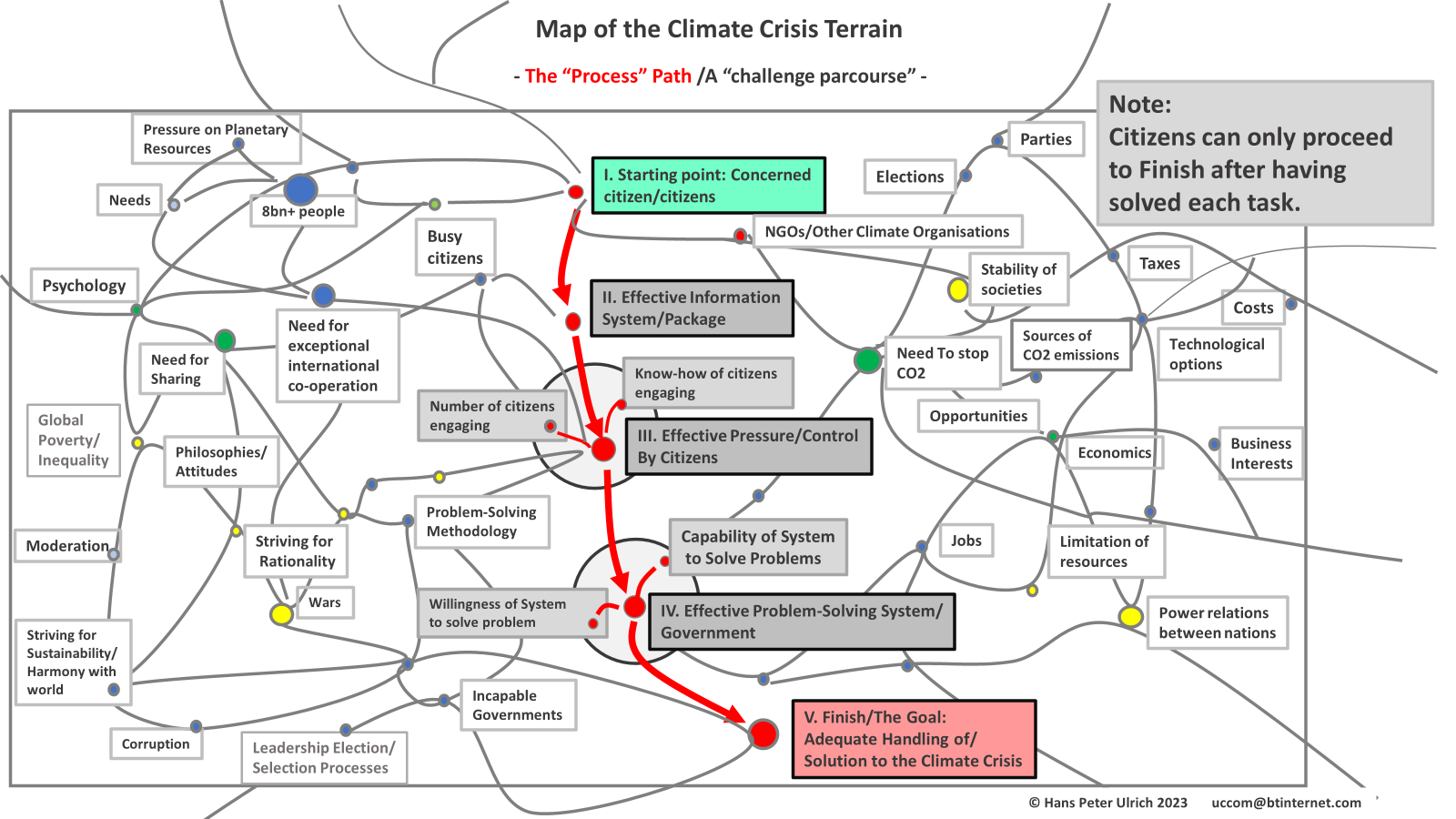
The image below tries to describe the complexity of the Climate Crisis problem in the form of a map in which the aspects of relevance affecting the stopping of climate change are represented as dots. In this figure the interconnecting lines are rather randomly drawn and simply meant to highlight the multiple interconnections between the aspects of relevance for the Climate Crisis. For effective climate policy making a comprehensive and precise analysis of the interconnections between individual factors is required. The overall number of points shown in the map, i.e., the number of aspects of relevance for solving the Climate Crisis, is by no means complete.
Our path to the problem solution
How do we find our route through this maze?
The systemic problem-solving approach appears to suggest the path highlighted in the map. Like in any passage through an unknown terrain, the route is first and foremost determined by the location, the aim which we must reach and which we are heading to. It is also defined by the points we must pass to get to this goal. The points on the path suggested on the “map” reflect what appears to be a logical sequence of factors which influence our goal achievement. We can also call the path a “challenge parcourse” to emphasise the need to complete a specific task at every step for us to be able to move forward to the next one. To understand the inherent logic of the path, I suggest looking at it backwards, from the goal, which we need to achieve, to the beginning.
1. Goal Definition
As regards the goal of our climate actions, the image suggests formulating it, at least to begin with, as “dealing adequately with the Climate Crisis”.
Such a wide initial goal formulation points to the need to, as a first step, verify and confirm precisely what our problem situation is to get everyone on board. As mentioned, NGOs like Extinction Rebellion (ER) have been calling on governments to “tell the truth”, i.e., to inform the people properly on the state of Climate Change and its implications. So far, the call has been in vain, our governments have not complied with it. Where governments fail to install an effective information system, we, civil society, must fill in. Once people have a joint understanding of the character and urgency of the problem, we can agree on more concrete goals, such as the 1.5° goal. While many observers suggest that, approaching the end of 2023, we have already surpassed it, others contend that reaching it “will save millions of people and it’s still feasible”. People already suffering from climate change would be “beseeching world leaders to hold global temperature rise to 1.5°C.”[19]
Given that the more we approach 2°C, the more we also increase our risk of hitting “tipping points”, points from where on the planet self-amplifies global warming and developments could get out of control, we probably simply ought to agree on stopping emitting greenhouse gases as soon as only possible while using all global resources available to achieve this aim. If we are already close to or above 1.5° of warming this means we have basically no leeway whatsoever left. We, humanity, need to consult openly and frankly about how to handle this situation.
2. The need for an extremely effective problem-solving or steering system
What are the factors affecting the achievement of this general goal, the “adequate handling of the climate crisis” in this global emergency situation?
Given the urgency of the problem and the overall complexity of the problem situation, including the physical developments in our natural environment and all other aspects determining how we, humanity, deal with the challenges – up to the potentially necessary interventions in the atmosphere to reflect sunlight mentioned above and their assessment – it becomes clear that we cannot solve the Climate Crisis without an extremely competent and effective problem-solving and steering system, to lead us through the complex problem terrain. (Point IV. in the image). That steering system is normally our government. I suggest understanding the governments in our nations concretely as “systems to identify, weigh, and manage public policy problems – in consultation and cooperation with the citizens”.
The image highlights that the effectiveness of our steering systems or governments in dealing with a problem is determined by two factors: Their willingness and their capability to deal with a given problem. If we want an effective steering system and an effective climate policy, we must ensure that our governments are both, willing and capable, to deal with such an extremely complex problem as the Climate Crisis.
3. The need for effective citizen control and pressure
This brings us to the need for effective pressure by the citizens on our governments, so they implement effective climate action. It also leads us to the need for effective “control” over our governments to ensure they are capable to deal with the climate crisis (Point III in the path).
UK Prime Minister Rishi Sunak just now, in September 2023, reduced the climate policy commitments of the nation, suggesting that there was a danger of “losing the consent of the British people” over a more stringent climate policy. [20] This highlights that government policy in a democracy is largely determined by the preferences of the people. If we want an effective climate policy, we need to ensure that the overwhelming majority of the people demand, rather than reject it, even if it requires sacrifices.
Moreover, Sunak’s statement highlights the critical relevance of leadership capacity especially in an emergency: A government with the ability to convince the population of the necessity even of painful measures will be able to generate and maintain the consent of the people to the required measures. When Churchill, in May 1940, heading his newly formed all-party government, declared to parliament and society in the UK that he had “nothing to offer but blood, toil, tears and sweat”, people followed him.[21] The Climate Crisis with existential yet not clearly noticeable threats looming over entire humanity requires leadership of an even higher calibre.
Democracy ultimately is government “by the people”, as one of the criteria coined by Abraham Lincoln. Through exerting effective control over our political system, we, the people, must ensure that our governments possess optimal government and leadership capabilities. Otherwise, we cannot handle the Climate Crisis adequately, we cannot stop it.
A reason why demands and protests by NGOs and climate protesters for effective climate policies have not generated the necessary results appears to be the fact the protesters so far failed to recognise the importance of and to implement effective strategies to ensure these two necessary factors are “in place”, the willingness and the capacity of governments for designing and introducing effective climate policies.
4. The need for an “effective information and motivation system”
If we want to create effective pressure and control by the citizens on, or over, our governments, we must understand the factors determining it.
As we recognise, the power of the people and their effectiveness in exerting pressure on and control over their governments, depends on the number of people exerting such pressure or control, and on their knowledge about what exactly they, we all, must do and demand to solve the Climate Crisis. To generate democratic majorities for the required climate policies, we formally need at least more than fifty percent of the people to call for them. But this ultimately does not suffice. To avoid polarisation in our societies and to ensure the effectiveness of the necessary climate policies we rather must aim for the support of the large majority of the population for the required climate measures, ideally for a consensus in our societies on their inevitability.
To generate such support for effective climate policies and the necessary pressure on the government to implement them, we need to inform citizens adequately. Following Checkland and Scholes who describe systemic problem solving as a “transformation process”[22], we need to create an “effective information and motivation system” (point II in the chart) with the aim to turn “passive citizens” into “active citizens”, so they engage and join the action suggested in the problem-solving path to generate effective climate policies.
Presently we do not have such an effective information system in place. As we discussed, some activists try to generate more action by gluing themselves to roads or by blocking other public infrastructure objects, such as bridges. This strategy appears counterproductive in that it turns off citizens rather than convincing them to take action. It also does not tell people what precisely we all must aim for, demand, and do to stop the Climate Crisis.
Generally, as Jonathan Freedland also describes in the Guardian, the information strategies by NGOs appear faulty and ineffective. He suggests that through their ineffectiveness the climate movement is “part of the problem too”, “they have not been communicating the threat (from the Climate Crisis) loudly enough or in the right way”, their terminology is “simply not understood by the wider public”. Freedland proposes that the climate community “must deploy whatever tools work to push a double message: both fear and hope. Fear for all the beauty, life and lives that will be lost from a parched planet – and hope that we still have time to avert the worst.” [23]
As our systemic analysis shows, Freedland is on the right path. Yet also his efforts have not produced the necessary results, so far, they have not been translated into an effective communication strategy by the climate movement. The publication of suggestions alone evidently does not suffice as a strategy to move us forward either. To move forward we need to take suitable action to create an “effective citizen information and motivation system” on the Climate Crisis. To give clout to such an endeavour it appears to make sense to convince the NGOs to change their strategies and for them to join in the sketched path towards effective climate policies.
It is encouraging that also a leading climate scientist like James Hansen, who testified in Congress in the US in 1988 about the dangers of Climate Change, confirms the urgent need for sound information for the public. As Hansen writes in November 2023: “A climate characterized by delayed response and amplifying feedbacks is especially dangerous because the public and policymakers are unlikely to make fundamental changes in world energy systems until they see visible evidence of the threat. Thus, it is incumbent on scientists to make this situation clear to the public as soon as possible.”[24] NGOs, climate scientists, activists, communication specialists, social media experts, psychologists, everyone concerned needs to work together to set up the effective information and motivation system required for the public around the world.
5. The concerned citizens as the “project drivers”
Any project needs a driver for it to go ahead and to be successful.
As becomes clear, the starting point in the suggested problem-solving path at the top of the image are we, the “concerned citizens”, those of us who cannot bear the news about the effects of extreme weather events and their devastating consequences all over the world anymore, those who are all too aware of the urgency and the existential threat of the Climate Crisis and of the need to take effective action. We need to take the initiative to set the described problem-solving process in motion. (Point I on the path, the starting point.)
As a first step we need to create the effective “information and motivation system” required in our nations to convince sufficient citizens to join our efforts. As many citizens as possible must then exert effective pressure and control over our governments, so they are willing and capable to design and implement effective climate policies. We must be careful, however. “Effective pressure” cannot mean that we or Climate NGOs push specific strategies through at all costs. It rather means pressure on governments to establish effectivepolicy making processes, including sound processes for the involvement of and consultation with wider society, to generate effective climate policies.
Some additional observations
What has been presented so far is only the barebone concept. Due to the manifold system levels and interconnections between the different issues many more aspects than those discussed appear of relevance.
How to ensure the utmost capability of governments?
A central open question is how to ensure the utmost capacity of governments, necessary for them to solve the climate crisis effectively together with the citizens. Achieving this goal requires a whole set of purpose-oriented actions on its own.
As Systems Thinking tells us and we now know, the first thing we need to do to ensure the effectiveness of our governments is to identify the factors affecting this specific goal. What are they?
Subject to review and discussion, I suggest they are:
- The equipment of our “steering systems” or governments with the necessary resources.
- Their equipment with the most committed and most intelligent staff a society can muster. (This includes our politicians.)
- The utmost effectiveness of all processes in the political system.
- The power of the governments to implement the required climate policies also against external, powerful interests.
Clearly, to equip our governments with the necessary resources required for them to function well, we must pay sufficient taxes and our economic circumstances must allow it. Countries whose economic systems do not function will have a harder time to make their governments effective. They will need support.
The second factor suggested affecting the performance of our governments, the selection of the most committed and capable staff, underlines that our current selection processes for our politicians, the elections which we hold, do not fulfil our requirements. We generally consider our election processes as given, but around the world they regularly result in the appointment of leaders who lack the integrity and professional qualifications to lead our nations and the world, in some cases blatantly so. A starting point for the solution of this problem would be to have public debates on the personal and professional qualifications required by our leaders, so we have a better idea which persons we can entrust the leadership of our nations and the world and who to elect. We should then also investigate in which way we can alter our selection processes for our politicians, so we get the leaders we require.
Further core processes determining the quality of climate policies are the strategy making and decision-making processes within a government system. A 2012 inquiry by the UK Parliament led to the following conclusion: “ We have little confidence that Government policies are informed by a clear, coherent strategic approach, itself informed by a coherent assessment of the public’s aspirations and their perceptions of the national interest… This has led to mistakes which are becoming evident in such areas as the Strategic Defence and Security Review (carrier policy), energy (electricity generation and renewables) and climate change”![25]
A lack of a “clear and coherent approach”? In plain language the Parliamentarians are saying that strategy-making in government is highly unprofessional and harms the nation substantially. Confirming the observation by Parliament on blatant deficits in strategy making by government the distinguished UK political scientists Anthony King and Ivor Crewe write in their account of the severe blunders UK governments have consistently committed over the past decades: “For all the fashionable talk about “prime ministerial power” and “presidentialism”, the truth is that looked at close up, British government turns out to be more chaotic than dictatorial”. [26] Governments in other democratic nations are likely to suffer from comparable shortcomings, due to similar construction principles in their political systems.
On one hand government blunders will be the result of the complexity of the challenges which governments are dealing with. On the other hand, they are caused by governments, whose politicians are not sufficiently trained and qualified for their tasks, and by strategy and policy making processes which do not function properly.
In a time when nations and the world face huge crises, instability, and conflicts, and when the Climate Crisis and the extinction of species even put civilisation at risk, we cannot afford chaotic governments and policy blunders, we must ensure that the necessary preconditions for government effectiveness are in place. For climate organisations to constantly demand effective climate policies from governments which lack the necessary capacity to design and implement policies of the required quality, without, however, taking suitable measures to mend these deficiencies, does not make sense and does not move us forward.
Regarding any “powerful interests” which might stand in the way of effective climate policies, we realise that the more citizens get involved in backing effective climate policies and in ensuring the effectiveness of our governments, the more certain will it be that such interests can be overcome and that policies necessary to protect the conditions of living on earth will be implemented.
A “Citizens’ Association for Effective Democracy”
As we noted above, all projects need effective drivers for them to be successful.
A concrete suggestion at this point, therefore, must be for us as citizens to create a “Citizens’ Association for Effective Democracy” in our nations which consults with society about exactly how to make government and the political system in general effective and which implements the necessary measures. Without such an effective driver we cannot ensure the effectiveness of our governments and we are unlikely to get a climate policy of the quality we need. Many people presently make suggestions for the improvement of policy making in government. The problem is that those proposals are not evaluated and implemented due to the lack of an independent organisation or “system” outside of government responsible for these tasks.
While the systemic need for “effective control” implies the necessity of a long-term citizens’ organisation ensuring the effectiveness of a democratic government, the realisation of this suggestion will be difficult. It requires a change in thinking of the public about their role in democracy. A simpler version of such a driver, which can be implemented quickly as an initial solution, would be the creation of an “Initiative for Government Effectiveness”by senior politicians and other persons. Operating beyond party affiliations, this initiative should examine and implement the measures required to ensure the necessary government capacity for dealing with such a complex problem as the Climate Crisis.
The creation of a “Government Performance Management System” as an instant measure
One general problem causing the blunders in government policy making observed by King and Crewe is the common perception by political leaders that they can govern simply based on personal perception and preferences.[27] Yet governing a nation of millions or hundreds of millions of people in a world of eight billion people clearly is an extremely complex task. To govern effectively, a head of government needs an effective system to examine the question what proper government precisely means and entails. Governing societies of millions of citizens and a world of eight billion people without such a system must even be considered negligent.
While a citizens’ organisation looking into the factors relevant for effective government would probably identify a “Government Performance Management System” as a central systemically necessary precondition for effective government, we cannot wait for such an organisation to be created and operational. In the light of the Climate Crisis looming over us and in the light of the many other problems our world is facing, ensuring optimal government capacity and operations through an effective “Government Performance Management System” is a matter of the greatest urgency.
Governments around the world, therefore, should already install such a system on their own initiative, without waiting for a citizen control system to point out its necessity. Politicians, pundits, the suggested initiative for government effectiveness by senior politicians, and finally also NGOs demanding an effective climate policy should call for such a system. If the British government had an effective “Government Performance Management System” in place, it would probably already be able to fix the serious deficits in its strategy making processes which Parliament identified already in 2012. For such a Government Performance Management System to be effective it appears evident that it also must comply with the systemic principles discussed in this paper.
The international dimension
Ultimately, everything we suggest here concerning the effectiveness of climate policy making has an international dimension. This dimension often appears neglected in our focus on national climate targets. At the same time, one often hears in private conversations that our nations would be emitting only a fraction of global CO2 emissions. One-sided national endeavours would be of no use, unless other, larger nations would go ahead with effective steps in stopping the CO2 emissions caused by them.
As Hawking points out and we underlined above, our success in solving the Climate Crisis and also the other huge problems humanity is facing including the extinction of species, poverty and inequality, as well as the over-exploitation of the planet’s resources in general, in fact depends on the entire population of the globe co-operating more intensely than ever before in the history of mankind and on governments around the world providing the necessary leadership. Yet, people in all democratic nations experience similar problems with the lack of willingness and capability of their governments to implement effective policies.
The people in all nations, at least in the democratic nations (also China declares that it is a democratic nation, albeit of a one-party character), must, therefore, in as much as only possible set the process for effective climate policy making described here in place. Rather than objecting to effective climate policies, they must jointly demand them from their governments. People in all nations must as well aim to ensure that their governments possess the necessary capacity to handle the enormous complexity of the Climate Crisis.
If we look around, the state of many governments in the world appears in fact catastrophic. Implementing effective global climate policy together with them appears difficult, if not impossible. We clearly need combined international efforts to establish effective governments also in these nations.
Ultimately, we need to reach out to all concerned citizens in the world for them to take – in as far as their circumstances only allow – the steps described in the suggested problem-solving path and to drive the necessary global climate co-operation forward.
To achieve this goal, we should also create a suitable driver, which we could call a “World Citizens’ Movement for Effective Climate Policy”, or maybe more widely, a “Global Citizens’ Movement to Protect the Planet”. Such a movement would present an inspiring umbrella for all concerned citizens around the globe to team-up and join in the necessary global co-operation on the Climate Crisis.
Conclusion
The aim to stop Climate Change and to solve the Climate Crisis confronts us with gigantic challenges. One of the central ones is the creation of co-operation of humanity on a level never seen before in the history of mankind. Especially in a time when we experience many conflicts around the world, the challenge of creating such a level of co-operation appears daunting. Many people will hold that achieving the required level of co-operation among eight billion people on earth is impossible given human greed and the widely entrenched competition between nations for economic, political, and military dominance.
But ultimately, when the alternative for humanity is to “cooperate or perish” as Antonio Guterres puts it, if it is “either a Climate Solidarity Pact – or a Collective Suicide Pact” [28], the choice appears clear. We must indeed create co-operation between all people of the world on a scale never seen before, as Hawking suggested already in 2016. We should trust that it is possible to achieve it – why wouldn’t it? – and start working.
Given the enormous dimensions and complexity of the Climate Crisis we must make all our efforts as effective and efficient as only conceivable from now on. Identifying our goals clearly and checking our strategies against the systemic yardsticks discussed will help us in achieving that goal.
Our discussion of the systemic problem-solving path generates a concrete plan for action. We must ensure that our problem-solving systems, our governments, operate with the highest degree of willingness and capacity conceivable so they can work successfully in the global fight against the climate crisis.
The concrete measures required to achieve this aim are:
- The creation of workgroups consisting of concerned citizens, climate scientists, NGO representatives, communication experts and other persons with relevant know-how in our towns which generate an effective information package and set up an effective information and motivation system for citizens in our nations and around the world so citizens fully understand the seriousness of the climate situation, demand effective climate policies, and support any efforts required in making government effective.
- The creation of a “World Citizens’ Movement for Effective Climate Policy”, as a home for citizens around the world wanting to join in these efforts.
- The creation of an effective initiative by elder politicians and other experts as a short-term solution to fix some evident performance deficits in our governments, such as the chaos and deficits in strategy making in the UK government observed by scholars and Parliament.
- The creation of effective “Government Performance Management Systems” based on systemic principles in democratic governments around the globe as an instant and central step to enhancing government effectiveness.
Even if the systemic approach and the four-point action plan presented here might appear absolutely rational and logical by establishing a clear link between the goals we need to achieve and the action we need to take, we still need to jointly assess it and consult on its validity. If we still have doubts, we need to work with the highest priority on finding a more effective approach as soon as only possible. If we agree on the soundness of the approach, we need to embark on it, with all available energy without any delay whatsoever.
This brings us to the ultimate precondition for our success in solving the climate crisis: Consultation. Given the urgency of the situation, we, the concerned citizens all around the world, everyone engaged in fighting the climate crisis, must get together from now on in regular consultations. We must evaluate our actions and focus on the central topic “How to end the Climate Crisis”? If we do not clarify the approach necessary to protect the planet and how to end the Climate Crisis, we cannot achieve our goals.
[1] António Guterres, Secretary-General’s remarks to High-Level opening of COP27, 7 November 2022, United Nations, https://www.un.org/sg/en/content/sg/speeches/2022-11-07/secretary-generals-remarks-high-level-opening-of-cop27
[2] Cf. for example: Cyrielle CABOT, ‘Every tenth of a degree matters’: UN climate report is a call for action, not despair, France24, 22 March 2023, https://www.france24.com/en/environment/20230322-every-tenth-of-a-degree-matters-un-climate-report-is-a-call-for-action-not-despairCLIMATE CRISIS;
[3] The information on the 2°C goal is from: Hansen et alii, Global warming in the pipeline, Oxford Open Climate Change, Volume 3, Issue 1, 2023, https://academic.oup.com/oocc/article/3/1/kgad008/7335889
[4] CF. Tsaoussi, A. (2021). Bounded Rationality. In: Marciano, A., Ramello, G.B. (eds) Encyclopedia of Law and Economics. Springer, New York, NY. https://doi.org/10.1007/978-1-4614-7883-6_106-2
[5] Cf. for example the overview by: Jonathan Rosenhead, What’s the Problem? An Introduction to Problem Structuring Methods, Interfaces 26: 6 November-December 1996, pp. 117-131, and also the volume: Jonathan Rosenhead and John Mingers (Editors), Rational Analysis for a Problematic World Revisited, Problem Structuring Methods for Complexity, Uncertainty and Conflict, Second Edition, Chichester, 2001
[6] Cf. Rosenhead, 1996
[7] This is a very abbreviated and slightly modified rendition of the problem-structuring approach described in Hans Ulrich and Gilbert Probst, “Ganzheitliches Denken und Handeln”, “Integrated Thinking and Action”, Ein Brevier für Führungskräfte, “A Breviary for Leaders”, Haupt, Bern, 1995. The subtitle “A Breviary for Leaders” is noteworthy in that it evidently highlights the understanding of Ulrich and Probst that our leaders in politics and business cannot operate effectively without constant reliance on the systemic principles described in the book.
[8] Cf. for example: Matthew Syed, Rebel Ideas, The Power of Diverse Thinking, London, 2019
[9] Timothy M. Lenton et alii, Climate tipping points — too risky to bet against, The growing threat of abrupt and irreversible climate changes must compel political and economic action on emissions. Comment, Nature 575, 592-595 (2019), doi: 10.1038/d41586-019-03595-0
[10] Cf. https://extinctionrebellion.uk/the-truth/
[11] Cf. for example: https://goodlawproject.org/update/net-zero-ii-launch/
[12] Oxford climate scientists: No doubt about climate change., University of Oxford, News and Events, https://www.ox.ac.uk/news/2021-08-09-oxford-climate-scientists-no-doubt-about-climate-change, accessed 28 November 2023
[13] https://fridaysforfuture.org/what-we-do/our-demands/, accessed 1 December 2012
[14] Michael Gove admits Government ‘not nearly enough’ has been done to tackle Climate change, ITV News, 23 April 2019, https://www.itv.com/news/2019-04-23/gove-admits-government-must-act-as-climate-change-protesters-reach-parliament
[15] Hansen et alii, 2023, Chapter “Perspective on Policy Implications”
[16] Ibid.
[17] Stephen Hawking, This is the most dangerous time for our planet, The Guardian, 1 December 2016, https://www.theguardian.com/commentisfree/2016/dec/01/stephen-hawking-dangerous-time-planet-inequality
[18] Ibid.
[19] Amy Martin, Meeting the 1.5°C Climate Goal Will Save Millions of People, and It’s Still Feasible, Opinion, Scientific American, 20 November 2023, https://www.scientificamerican.com/article/meeting-the-1-5-c-climate-goal-will-save-millions-of-people-and-its-still-feasible/
[20] Pippa Crerar, Fiona Harvey and Kiran Stacey, Rishi Sunak announces U-turn on key green targets, The Guardian, 21 September 2023, https://www.theguardian.com/environment/2023/sep/20/rishi-sunak-confirms-rollback-of-key-green-targets
[21] cf. for the quote: International Churchill Society, https://winstonchurchill.org/resources/speeches/1940-the-finest-hour/blood-toil-tears-sweat/, accessed 21 September 2023
[22]Peter Checkland and Jim Scholes, Soft Systems Methodology in Action, John Wiley and Sons, 1990, p.p. 34
[23] Jonathan Freedland, As heat records break, the climate movement has the right answers – but the words are all wrong. The Guardian, 14 July 2023, https://www.theguardian.com/commentisfree/2023/jul/14/big-oil-climate-crisis-fossil-fuel-public
[24] Hansen et alii, 2023
[25] House of Commons Public Administration Select Committee, Summary of Report: Strategic thinking in Government: without National Strategy, can viable Government strategy emerge?, Twenty Fourth Report of Session 2010–12 , Volume I: Report, together with formal minutes, oral and written evidence, Ordered by the House of Commons to be printed 17 April 2012
[26] Anthony King and Ivor Crewe, The Blunders of our Governments, Oneworld Publications, London, 2013, p.314
[27] Cf. King and Crewe, pp. 255
[28] António Guterres, 2022
 optimisingdemocracy