Tag Archives: New Prime Minister

Andy Burnham will fail too – Unless he identifies the foundations of proper government

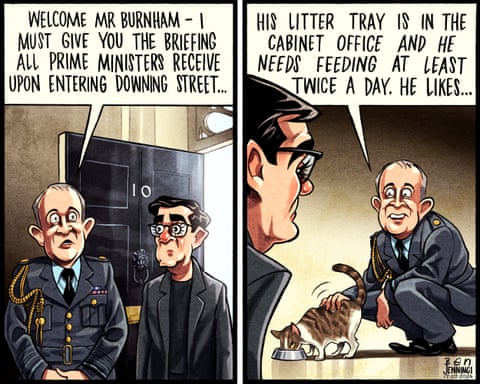
Never mind what the series of recently rather short-term renters in Number 10 Downing Street have been occupying themselves with. The main thing is they know how to take care of the cat, the apparently most enduring occupant at the residence.

One must grant it to Ben Jennings. His sketch in the Guardian on 17 July 2026 presents a piece of utterly funny, self-deprecating humour in the face of the painful fact that the country has not been able to produce one successful head-of-government during the last ten years who would have been capable to ensure the contentment of the people over at least a full-parliamentary period, a fact increasingly undermining trust in UK democracy and harming the nation.

But why exactly did the six previous PMs fail? And what must he do differently? Those are the critical questions Andy Burnham must look into, if he does not want to be the next in the line and hand over the keys to PM number eight in another two or three years’ time.

The problem of governing on the basis of personal convictions only

If we look over the series of six short-term Prime Ministers over the last ten years, one thing which they had in common is that they all governed following their own personal ideas and convictions about how to govern and to run a government. One result was David Cameron’s “Big Society” project for example, a project not thought through and born “dead in the cradle”, as even members of the Conservative Party suggested. Dominic Cummings, chief advisor of Boris Johnson, published a job advertisement calling for “weirdos and misfits with odd skills” to apply to government. Fresh ideas might be useful, but where is the structure in such an approach? And there was obviously Liz Truss, whose unusually “personal approach” to government collapsed after only six weeks.

Yes, Andy Burnham might have a different personality from his predecessors, radiating optimism and a can-do-attitude. One question we might want to ask is, why a nation would have to go through six unsuccessful heads-of-government to finally arrive at a successful one on the seventh turn only. But there, unfortunately, already are indications that Burnham is falling into the same trap as his predecessors. “I know what I want to do, working with you all“, he declared in his speech as the new leader of the Labour Party and designated new Prime Minister. “I have a plan”, he continues, “and what I also want you to know is that I won’t change. I have a style; it’s my style.”

Yet, ultimately, this is what all six unsuccessful Prime Minister’s before him had as well, a “plan” and their “style”, their “personal idea” on how to run a country and its government machinery. At first the people did put their hope in them; approval rates were high. Then their approval rates dropped, partly rapidly so. Once in office, the newly elected leaders disappointed the people and failed.

Identifying the foundations for an effective and stable government

Clearly, one cannot build a stable skyscraper without laying proper foundations for it. This is also valid for governing a nation of tens or even hundreds of millions of people in a complex world of eight billion people and for running a complex government machinery of thousands or perhaps a million people, a hugely difficult task. One cannot build a stable and effective government, without laying sound foundations and reflecting systematically and thoroughly about what governing means and requires.

But what are those foundations for effective and successful government?

Ultimately, clarifying this answer requires comprehensive consultation and the input of all relevant know-how in society.

The very first precondition, one might suggest, however, is the understanding by a head-of-state that running a nation of millions of people in a complicated world of billions of people cannot be subject to personal ideas and convictions of individual persons on how to govern. A head-of-state must be ready to investigate what sound methodical and systemic foundations for governing are. This is what we must learn from marvelling at the series of six failed, short-term  Prime Ministers in a row. (Well, they tried. Maybe that must be acknowledged.)

Second: One needs a hammer or a similar tool to drive a nail into a board. Likewise, a head-of-government needs a tool, a system, concretely a “Government Performance Optimisation System” to optimise the performance of the government machinery. It is a logical necessity. There is no way around it. A single person cannot lead a huge government machinery of thousands or perhaps a million people effectively by him- or herself. The task of this Government Performance Optimisation System must be to systematically reflect on and research the question how to govern optimally and how to make the government system perform optimally. Given the logical necessity of such a system, for any head-of-government not to install a Government Performance Optimisation System must be considered negligence in the execution of his or her duties towards their nation.

Third: Logically the first step in clarifying the foundations of proper government for the  Government Performance Optimisation System to take, must be the identification of the very best methodology or methodologies for ensuring “optimal government performance”.

One reason why the previous Prime Ministers failed is the fact that they all thought their own intelligence, experience, and personal convictions would be sufficient to run government successfully. They failed to recognise and acknowledge that our rationality including their own is “bounded”. It does not suffice to deal adequately with the huge complexity of our world. This is why we need Problem Structuring Methodologies, also called “tools for thinking” for solving complex problems, including also for determining, how to govern a nation properly. Clearly, running a nation in our complex and unhinged world is a hugely difficult task, whichever tools we might use to govern more effectively. Yet, if the six failed PMs had analysed systematically with the help of such Problem Structuring Methodologies what it means and requires “to govern properly”, they might still be in office.

One fundamental mistake which our governments make and which is the outflow of a lack of sound methodical thinking about governing is the idea that they need to preserve democracy by showing that “democracy can deliver”. US President Joe Biden expressed this reasoning in a major speech before Congress in April 2021: “We have to prove democracy still works — that our government still works and we can deliver for our people.” He failed, at least in convincing the people of his achievements, with the dire consequences for the US and the world we see. Burnham also declares: “…people are looking for us to deliver, and we will.”

But in a complex and changing world no head-of-government can wave a magic wand. No government system, however effective it may be, may be able to “deliver” what people expect, jobs, satisfactory income, low cost-of-living etc. But without a functioning democratic steering system our societies will collapse. People need to hold on to democracy, even if it fails to fulfil all their wishes. A systematic analysis of the foundations of government will show that preserving democracy must be a prime policy issue in its own right and that government must design suitable policies to achieve this aim, including an effective citizenship education system. As far as our economic well-being is concerned and the many other challenges our societies face, the only thing we can and must aim for is to make our democratic government systems perform optimally, so they are able to deal as effectively and efficiently as possible with these challenges. Even in a difficult world, one overall aim we must pursue is to maintain a co-operative and sound society on the basis of a functioning democracy.

For Andy Burnham, a “personal plan” and “aiming to deliver” will not suffice, just as it did not for his predecessors. If he wants to be successful in serving the nation, stay in office, and stabilise UK democracy, he now must establish sound foundations for his government with the help of an effective Government Performance Optimisation System. He must systematically and comprehensively think about what governing effectively means and requires. If he does not do it and, and if he, just like the previous heads-of-government, continues governing based on personal ideas and convictions only, then he is likely to fail just like them and will further weaken UK democracy and harm society. Any head-of-government in any democratic nation must optimise the performance of government for the sake of their nation, of the people, and the world.

UK Leadership Contest: Open Letter to the Members of the Conservative Party

Dear Members of the Conservative Party,

The fate of the nation now again is in your hands.

Britain is at a crossroads, between a direly needed turn towards a rational politics serving the nation and its citizens or towards ever more irrationality, government blunders, and scandals harming and weakening the nation further.

People want a politics of integrity they can trust. People will trust in a politics of transparent and convincing rationality. Continuing a politics of irrationality will not only continue to harm the nation. It will undermine trust in both, politics and the Conservative Party.

The Conservative Party wants to win elections. Initiating a sound politics of rationality in which people can trust will win elections for the Conservative Party, not the cheap and populist look to what people might think and feel about personalities.

What can and should the members of the Conservative Party do to ensure the direly needed turn to rationality in British politics?

Two steps appear necessary:

  1. Implement in as much as possible at this stage a rational method for electing the new Prime Minister

A nation which wants a qualified leader must necessarily start with choosing a rational method to selecting its leader. Otherwise, the selection process may lead to results which ultimately nobody wants and which harms the nation. The  approach implemented by the 1922 Committee, however, is highly unprofessional and ineffective. It points to huge deficits in the know-how of systemic and rational methods of problem solving and decision making in the political system which urgently need to be corrected. Already the near to four-year paralysis of the political system through the Brexit decision making process highlighted these shortcomings, independently of the result of the decision.

The professional method of choice for deciding between various options for action is the “Analytic Hierarchy Process”. In selecting the candidate for a job, it relies on a logically necessary sequence of steps, starting with identifying the precise demands of the tasks and the qualification criteria to be applied. In a second step it weighs the decision criteria against each other and determines the most important ones. As a final step it selects the candidate who best fits the overall set of qualification criteria required.

The current selection process appears so superficial and chaotic (and does not help you in making your decision), because it does not take these rationally necessary steps, it neither identifies the qualities and qualifications required from a future Prime Minister precisely, nor does it determine the most important ones, nor does it take suitable steps to measure in how fare each candidate fulfils these criteria. It embarks instead on an endless discussion of individual policy proposals which due to the complexity of each issue and our own inability to judge what is right and wrong on such complex issues is largely unsuited to identifying the relevant qualities of the candidates.

To mend those fundamental deficits in the application process, the Conservative Party at this point basically has two options: To stop the botched selection process completely and start all over in a properly structured way, or to incorporate as many elements as possible of the rational decision-making process in the remaining phases of the selection process under way.  Given that the nation needs a functioning government I suggest turning to the second alternative.  

Ultimately the complete list of criteria to be applied in selecting the leader of a nation must be discussed and created in a thorough consultation process. Some of the main criteria appear to be:

This third qualification criterion is necessary because in our complex world no person is smart enough to determine effective policies on their own. In a world facing huge challenges, any head of government must lean on the government system for their policy making and, therefore, must ensure it operates optimally.

An abbreviated application of the Analytic Hierarchy Process would probably suggest that “intelligence” and “integrity” are the decisive criteria.

Rishi Sunak clearly seems to beat Liz Truss on the criterion of intelligence (his appearance and way of talking, his credentials, his training at Stanford University etc.)

In assessing candidates, debates can be misleading. One must rely to some degree on references.

What do people who know her, say about Liz Truss?

These quotes from the Guardian appear to be largely reliable and indicative:

“Her critics (state) – She fails to display intellectual gravitas, they say, relying instead upon cheap slogans, and struggles to make convincing speeches, another facet of her character that could be quickly exposed under the intense scrutiny of Downing Street.

Dominic Cummings, Boris Johnson’s former chief adviser, told the online magazine UnHerd in May that Truss was “as close to properly crackers as anybody I have met in parliament” and would be an “even worse” prime minister than Johnson.”

Even if one were to harvest reservations against Dominic Cummings, the statement appears independent and worth consideration. More important even appear these observations:

“Others doubt if Truss really believes anything she says, and relies upon a gut instinct to fulfil her own ambitions. Anna Soubry, the former MP who served as a minister alongside Truss, said many had questioned whether she had the skills necessary to lead the UK.

“She was the most ambitious person many people had encountered. I honestly believe she was given jobs – ministerial promotions – just to shut her up. Her ambition is, undoubtedly, considerably greater than her ability,” said Soubry.” (‘Ambition greater than ability’: Liz Truss’s rise from teen Lib Dem to would-be PM | Liz Truss | The Guardian)

In summary:

  • She fails to display intellectual gravitas (i.e. intellectual ability) and relies on cheap slogans
  • Her ambition is undoubtedly greater than her ability
  • She would be an even worse Prime Minister than Boris Johnson

These three statements from people who know her have enough substance to exclude any applicant as a candidate for the office of Prime Minister and as the leader of a nation in the first round of a properly implemented selection process. Not only the degree of her intelligence is questioned in these observations. Also the integrity of a person who relies on “cheap slogans”, a statement affirmed by the debates, must be in doubt.

For the sake of rationality and trust in politics, for the sake of the nation and given the state of the current selection process as it is, it appears that the members of the Conservative Party must choose the most intelligent and capable among the remaining candidates, they must choose Rishi Sunak as the Prime Minister. Nothing stops the party from using the two years to the next election to review the selection process for their leader.

2. Ensuring a fundamental turn to rational politics in the UK

Both candidates do not fulfil the third crucial criterion, necessary for the well-being of the nation: The competency and willingness to ensure the highest effectiveness and efficiency of the government system. (We do not hear them say that this is what they will do as the first step in office and they probably do not have the competencies for it.)

Ultimately ensuring this criterion for the choice of the Prime Minister requires that we, society and everyone in politics, rethink our approach to politics. We must ensure that the entire political system uses professional and rational methods in the way it operates. Our entire world, our societies and our governments are “systems of systems”. The fundamental approach to government it appears must be interconnected thinking, “Systems Thinking”. To ensure rationality and trust of the people in politics the political system must, furthermore, apply rational problem-solving and decision-making methods.

Such an approach to politics informs us that in order to ensure rationality in politics a new Prime Minister must start his or her work with a fundamental inquiry into what rational government means at all. He or she must also investigate in a public consultation process how to optimise government policy making and verify the above suggestions on the foundations for effective government. Otherwise, a Prime Minister cannot govern effectively.

Systems Thinking tells us that everything in our world is interdependent. In government this insight reveals the logic that there cannot be effective government without an effective Government Performance Management System and that there cannot be an effective Government Performance Management System without incorporating all know-how available in society and the world on the matter in a constant and open consultation process.

In the Conservative Party there is some discontent about the ousting of Boris Johnson. What these considerations tells us, however, is that Boris Johnson, even if he is in many ways an extraordinary and highly admirable personality, unfortunately one might say, was not suited as a Prime Minister and that he probably should not be in politics at all, but perhaps in entertainment (unless he completely changes his approach to politics). He is a person to whom, as already his headmaster stated, “rules do not apply”, he appears to consider government a sport, rather than a task which requires a thorough, analytical approach, his government, as a consequence, was a government of chaos not rationality. The infinite series of scandals during his government, furthermore, put his integrity in question and harm the trust of the people in the political system. The UK needs a more rational approach to policy making. Rishi Sunak did the right thing in helping to end Johnson’s time in power and should be supported not criticised for it. 

Conclusion

The British people want and urgently need a government they can trust in.

To ensure rationality and the trust of the people in politics the Conservative Party must select the clearly most intelligent and most capable candidate, a person of integrity as the Prime Minister.

As regards the qualities of the candidates the fact that someone happens to be rich should not

rule him or her out as a candidate, if he or she otherwise happens to be the most suited candidate for the position as PM.

But one core requirement related to integrity is the commitment of the PM to serving society as a whole. The fact that together with his wife he owns more than three quarters of a billion pounds might actually put Rishi Sunak in a conflict of interest with his duty to serve the nation.

In 2016, the world-renowned physicist Stephen Hawking, a man of the highest degree of intelligence, suggested in simple and powerful words that for rescuing our nations and the planet “with resources increasingly concentrated in the hands of a few, we are going to have to learn to share far more than at present.” In practical terms this suggestion might necessitate to tax the rich in our nations and the world to a higher degree. Many people in the world, even rich ones themselves, advocate this thinking. If we want to protect our world and societies, we will have to examine our approach to this issue.

In this context it seems important to consider society an organism in which every part is responsible for the health and resilience of the organism. If we manage to make society healthy and resilient, it has the greatest chance to overcome the challenges, we are facing, to attract investment, and to generate adequate well-being for everyone. A rational government must initiate a debate on the suggestion by Hawking. But this is only one aspect of relevance for an effective government. Given the state of the application process we are in, I suggest giving Sunak a chance at least until the next election and to see how he handles this matter and policy making in general. Ultimately, whoever is in office, it is also the effectiveness of political control which decides over the quality of policy making, not the person alone.

Finally, also the skin colour of the applicant appears to, in fact, play an unstated role in the decision-making process. It should not have any relevance.

If we want our societies to flourish, we all must embrace reality, ideally as quickly as possible. Not embracing reality harms and weakens our nations. The reality of our world is that the composition of the population of nations has always changed in the course of history and that today also western nations have become multiracial. We should appreciate the richness this racial diversity brings to our nations. For the sake of our societies, we should choose the most able person to lead our governments.

Next to selecting the most suitable candidate for the job as PM the Conservatives must start now a fundamental rethinking in politics on how to establish rationality and trust in government. Concretely they must ensure that the new Prime Minister takes the steps required to ensure the highest effectiveness and efficiency in government.

After years of blunders and scandals in government, the UK now needs a government of rationality. The Conservatives have the choice to initiate this change. Not doing so might for years to come set the UK on course of further ineffective governments. It would seriously compromise the ability of the nation to cope with the severe challenges it is facing and harm and weaken the nation further.